What a Modern Sculpture Manufacturer Must Get Exactly Right
A modern sculpture manufacturer works in a visual language with nowhere to hide. Contemporary work tends to reduce form to essentials, which means every seam, every deviation in a curve and every inconsistency in a surface becomes part of the composition. Ornament can absorb error; minimalism magnifies it. That is why modern sculpture is often the most demanding work a manufacturer can take on.
Yifeng Sculpture Studio has produced contemporary work since 2003 in stainless steel, mild steel, aluminium, bronze, composite and glass, with more than 3000 delivered works across 23 countries. A modern sculpture manufacturer is judged on precision and restraint, and our engineering and production teams work in the same building as our designers precisely so that the precision can be designed in rather than chased at the end.
Precision Is the Whole Aesthetic
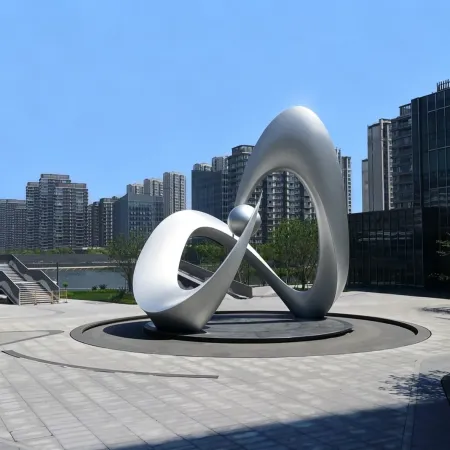
In a minimal work, a two-millimetre step between two panels is not a small defect; it is a visible break in the surface and it will read from across a plaza. The tolerances that would be generous in a decorated piece become unacceptable in a clean one, and the manufacturer must set the geometry, the tooling and the assembly sequence to hold those tolerances across the whole work rather than on average.
Holding tight tolerances at scale requires method. Parts are cut from a common setting-out, jigs hold the geometry during welding, distortion is controlled by sequence and heat input and measurements are taken against the master datum at defined stages. A modern sculpture manufacturer that measures only the finished piece is measuring too late, because by then the only remedy is filler and abrasives, and neither belongs in a contemporary surface.
| Detail | Why it shows | How we control it |
|---|---|---|
| Panel flatness | A mirror finish turns every wave into a distortion | Matched panels, tuned wall thickness, staged measurement |
| Seam placement | A joint across a clean face interrupts the reading | Joints set on changes of plane, dressed and blended |
| Edge quality | Thin edges are the signature of the form | Machined or dressed edges, uniform radius, no witness marks |
| Fixings and base | Visible hardware breaks a minimal composition | Concealed connections and a base detailed to disappear |
Surface, Reflection and the Behaviour of Light
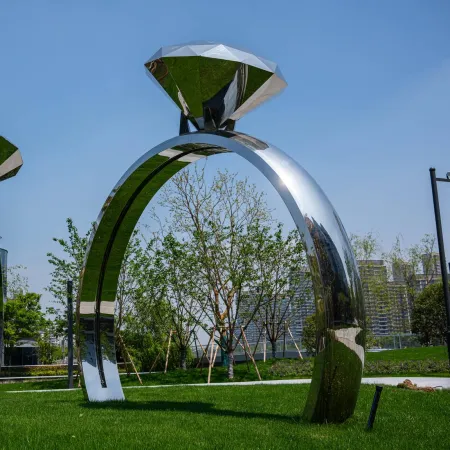
Contemporary sculpture often uses light as a material, whether through a mirror polish, a brushed direction or an integrated lighting programme. A mirror surface is the most revealing finish available: it shows the sky, the ground and the viewer, and it also shows every flaw the manufacturer has failed to remove. Producing a large mirror surface that reads as continuous is one of the hardest tasks in metalwork, and it begins with geometry rather than with abrasives.
Where lighting is integrated, the light must belong to the form rather than sit on top of it. Fixtures should be concealed, cable routes planned inside the structure, drivers placed where they can be serviced and the light output balanced so the work does not develop dark patches or hotspots. A modern sculpture manufacturer that treats lighting as an afterthought produces a beautiful object with an obvious technical attachment; one that designs it in produces a work that seems to generate its own light.
- Design the light in: fixtures, cable routes and drivers planned with the form so nothing is bolted on afterwards.
- Balance the output: even illumination across a large curved surface so the work does not read as patchy at night.
- Protect the surface: masking and padding through fabrication, transport and installation so the finish arrives unmarked.
- Conceal the hardware: hidden connections and a base detailed so the work appears to meet the ground without assistance.
- Approve in real light: samples judged in daylight and under the site's night lighting before production begins.
Restraint in Detailing and Engineering
Contemporary work demands engineering that does not announce itself. Stiffeners must be hidden inside the form, drainage must be invisible, anchors must disappear into the base and any movement joint must be detailed so it reads as a deliberate line rather than a gap. This is where a manufacturer's design intelligence matters as much as its workshop skill, because the solution must satisfy the engineer and the eye at the same time.
Restraint also applies to the number of decisions. A minimal work usually has one dominant idea, and every additional detail dilutes it. A modern sculpture manufacturer should be willing to tell a client when a fixing, a plaque or an added element will weaken the composition, and should propose an alternative that achieves the practical purpose without intruding on the form. That kind of advice is worth more than another coat of polish.
Where Modern Work Is Won
Tolerances held across the whole work, not on average
Seams placed where the eye will not look for them
Lighting designed into the form rather than added to it
Engineering that leaves no visible trace
Maintenance and the Long View
A contemporary finish is usually a visible finish, so its maintenance expectation should be stated clearly. A mirror-polished stainless surface needs regular cleaning to remove fingerprints, salt and pollution, and it will show every mark until it is cleaned. A brushed surface is more forgiving. A coated surface can be washed and touched up. The client should know which regime applies before the work is installed rather than discovering it in the first month.
The long view also includes repairability. If a minimal work is damaged, the repair must be invisible, which means the manufacturer needs to have kept the finish specification, the tooling and a matching repair system. A modern sculpture manufacturer that archives those things makes a future repair a routine operation instead of a permanent scar on a surface that has nowhere to hide it.
- Set tolerances deliberately: define what a visible deviation is for this work and hold it across every part rather than on average.
- Plan joints for the eye: put seams on changes of plane, and dress them so the reflection runs continuously across them.
- Integrate the lighting: concealed fixtures, planned cable routes and reachable drivers, with output balanced across the surface.
- State the cleaning regime: what the finish needs, how often and which products will damage it, given to the owner in writing.
- Archive the finish: specification, samples and a matching repair system kept so damage can be corrected invisibly.
Protecting a Flawless Surface Through Delivery
A contemporary finish is most at risk between the workshop and the site, when the work passes through packing, loading, transport, unloading and installation. Every one of those stages offers an opportunity for a scratch, a scuff or a fingerprint that cannot be polished out on site. Protection therefore has to be designed rather than improvised: masking film on finished faces, padded cradles built to the shape of each section and lifting points that do not touch a visible surface.
Unveiling is the final step and it deserves its own attention. Protective materials are removed in a controlled sequence, the surface is cleaned with the correct products and the work is inspected in the light of the site rather than in the shadow of a van. A modern sculpture manufacturer plans that sequence in advance and keeps the cleaning materials on hand, because the difference between a work that arrives immaculate and one that needs a return visit is usually a few hours of discipline.
Frequently Asked Questions About a Modern Sculpture Manufacturer
Can a mirror finish be produced on a large curved form?
Yes, but only when the geometry is correct before polishing. Panel flatness, wall thickness and weld sequence all have to be controlled, because a mirror turns every deviation into a distortion.
How do you hide fixings on a minimal work?
By designing concealed connections and detailing the base so it appears to meet the ground without hardware, while still satisfying the structural requirement.
Can lighting be integrated without visible fixtures?
Yes. Fixtures are concealed within the form, cable routes are planned inside the structure and drivers are placed in an accessible compartment for service.
What maintenance does a polished surface need?
Regular cleaning to remove fingerprints, salt and pollution. We hand over the recommended frequency, the products to use and the ones to avoid.
Can damage be repaired invisibly on a clean surface?
Usually yes, provided the finish specification and samples were archived and a matching repair system was supplied at handover, which we do as standard.
A modern sculpture manufacturer is working without the cover that ornament provides. Every tolerance is visible, every seam is read, every surface is examined by the light it reflects. That is demanding, and it is also why contemporary work is so satisfying to deliver well: nothing can be hidden, so nothing is left to chance.
Contemporary work across materials is shown in our project gallery, the process from design to installation is set out in the services overview, and Eye of the Phoenix shows how precision and light can carry a contemporary form.
Send us the geometry and the finish you have in mind, and we will tell you what it takes to hold it. A modern sculpture manufacturer who talks about tolerances before aesthetics is one whose minimal work will still look intentional in a decade.