Landscape Sculpture Fabrication That Belongs to the Ground It Stands On
Landscape sculpture fabrication is the craft of making a work that belongs to its ground rather than merely occupying it. A sculpture dropped onto a finished landscape will always look like an arrival; one that is designed with the contours, the planting, the drainage and the paths becomes part of the place, and visitors cannot remember a time before it stood there. That difference is made in the workshop and in the coordination that precedes it.
Yifeng Sculpture Studio has fabricated landscape works since 2003, delivering more than 3000 pieces to 23 countries, and we work regularly alongside landscape architects because the coordination is where the quality lives. Our designers and engineers share one building with our craftsmen, so a landscape commission is resolved as a whole rather than as a sculpture plus a site.
Designing With the Ground, Not On It
The first question in landscape sculpture fabrication is where the ground goes. A work can sit on a plinth, sink into a slope, rise from water, bridge a path or emerge from planting, and each choice changes how the form is fabricated. Sinking a work into a slope means the base must be designed for soil pressure and drainage; rising from water means the structure must resist corrosion and the finish must tolerate splash and reflection; bridging a path means the work must be safe from below as well as from the side.
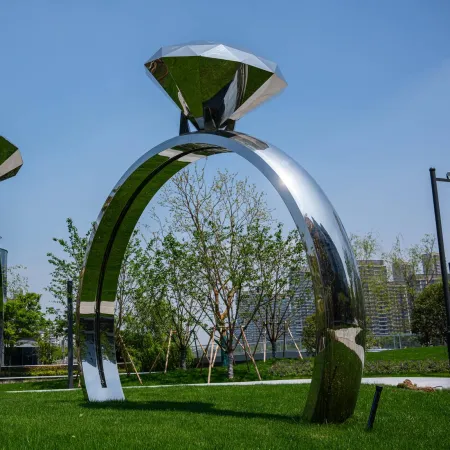
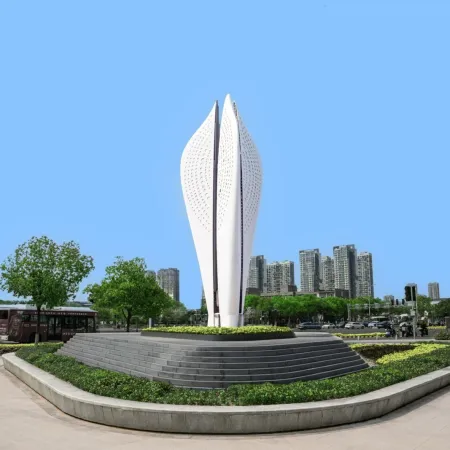
The second question is what the work will be seen against. A pale form against dark evergreen planting reads very differently from the same form against open sky, and a highly reflective surface will mirror the trees while a matte one will absorb them. We ask the landscape architect for the planting plan and the seasonal palette, because a sculpture chosen without that information is a sculpture chosen blind. Fabrication decisions about colour and finish follow from the surroundings rather than from the studio's taste.
| Landscape setting | Fabrication consequence | What it protects |
|---|---|---|
| Slope or embankment | A base designed for soil pressure and drainage | Stability and a dry, uncorroded footing |
| Water feature or pool | Marine-grade alloy and splash-tolerant finishes | A finish that survives constant moisture |
| Over a path or bridge | Safety designed for people passing beneath | Public safety and clear headroom |
| Dense planting | Colour and tone chosen against the palette | A work that reads in every season |
Coordinating With the Landscape Team
The best landscape projects have the sculptor in the room when the layout is still being drawn. When the sculpture is designed with the paving grid, the lighting circuit, the irrigation and the planting plan, its footing can be cast once in the right place, its cables can be routed before the ground closes and its delivery can use access the landscape design preserves. Retrofitting a sculpture to a finished landscape means cutting paving, moving plants and negotiating with systems that were never designed to receive it.
We ask to see the landscape drawings early and we mark up what we need: the load capacity of the ground, the position of services, the access route for delivery and the lighting supply. Those requirements are simple when they are asked for early and expensive when they are discovered late. A landscape architect who receives a clear list of interface requirements from the sculpture fabricator can plan around them, and the finished scheme benefits from a coordination that the visitor never notices.
Materials That Sit Well in a Landscape
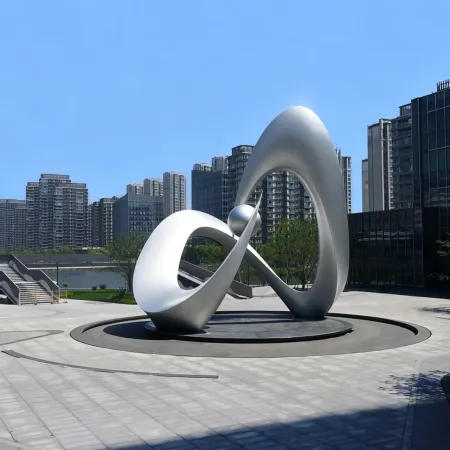
Weathering steel is a favourite in landscape work because its rusted surface tones with bark, soil and stone and needs no coating, though its runoff can stain paving and must be managed with a designed base or a tray. Stainless steel offers a bright, clean counterpoint and reflects the planting around it, and cast bronze gives warmth and permanence. Stone and concrete give mass and calm, and coated steel or composite allow colour where the scheme calls for it.
Each material carries a maintenance consequence that the landscape owner must accept. Weathering steel will continue to rust and stain; stainless steel will show fingerprints and water marks; bronze will change colour over the years. We set those consequences out plainly, because a landscape manager who is surprised by staining will not be a friend of the sculpture. In landscape sculpture fabrication the honest conversation about ageing is as important as the design conversation about form.
What a Landscape Setting Requires
A footing designed for soil, slope and water rather than for paving
A tone chosen against the planting, not in isolation
Interface requirements listed early, while the ground is still open
An honest account of how the material will age and stain
Installation Without Destroying the Landscape
Installing a sculpture into a finished landscape is a delicate operation, because the machinery needed to lift a heavy form can ruin planting and compact soil. We plan the installation route in advance, use ground protection mats and plates, and where the access is too tight we design the work in sections that can be carried by hand. A crane that reaches over a mature tree is a better solution than a crane that drives through a lawn, and the choice should be made at the design stage rather than on the day.
Reinstatement matters too. Where the ground must be opened for a footing or a cable, the planting and the surface must be restored to a standard the landscape architect accepts, and that requirement should be written into the installation scope rather than assumed. We photograph the site before we start and after we finish, so that any damage is identified and repaired rather than discovered months later. Landscape sculpture fabrication is not complete until the landscape looks as though nothing happened.
Care Over the Long Term
A landscape sculpture will be maintained by grounds staff who have a great deal else to do, so the care plan must be short, clear and realistic. We supply a one-page schedule naming the cleaning products, the inspection intervals and the first parts that will need attention, and we keep the finish specification on file so a future repair can match the original. A sculpture that is easy to care for is a sculpture that will be cared for.
We also recommend a review at the end of the first year, when settling, drainage and planting have all had a season to act on the work. That visit catches small issues while they are still small and gives the grounds team a chance to ask questions while the makers are available. Clients who take up the review get a sculpture that ages gracefully and a landscape that keeps its centrepiece, which is the whole purpose of careful landscape sculpture fabrication.
Trees, Roots and the Space Around a Work
Existing trees are both the greatest asset and the greatest constraint in a landscape commission. Their roots extend well beyond the canopy, and excavation within that zone can kill a mature tree that the client has spent decades growing. We survey the root protection areas before designing the footing, and where a foundation must fall inside one we use a raft or a pier design that minimises excavation and keeps the root zone intact.
The space around the work matters just as much as the work. A sculpture needs room to be approached, seen and walked around, and it needs a clear zone that the mower and the maintenance crew can reach without damaging planting. We agree the clearances with the landscape architect and mark them on the drawing, because a sculpture crowded by shrubs will lose its silhouette and a sculpture surrounded by long grass will look neglected. Good landscape sculpture fabrication plans for the maintenance that will follow.
Frequently Asked Questions About Landscape Sculpture Fabrication
How early should the sculptor join a landscape project?
As early as the layout stage, so the footing, services, lighting and access can be planned into the scheme rather than retrofitted to it.
Which material suits a landscape best?
Weathering steel tones with planting, stainless steel reflects it, bronze warms it, and stone or concrete calm it, so the choice should follow the scheme.
Does weathering steel stain paving?
Yes, its runoff can stain, so it must be placed with a designed base or a collection tray, and the owner must accept the staining as part of the material.
Can a sculpture be installed without damaging planting?
Yes, by planning the access route, using ground protection and designing the work in sections that can be carried where machinery cannot reach.
What maintenance does a landscape sculpture need?
Gentle cleaning, periodic inspection of fixings and finishes and a first-year review, all set out in a schedule grounds staff can follow.
A landscape sculpture succeeds when nobody can imagine the place without it. That takes a form that suits the ground, a material that suits the climate and a coordination that begins before the first drawing is fixed.
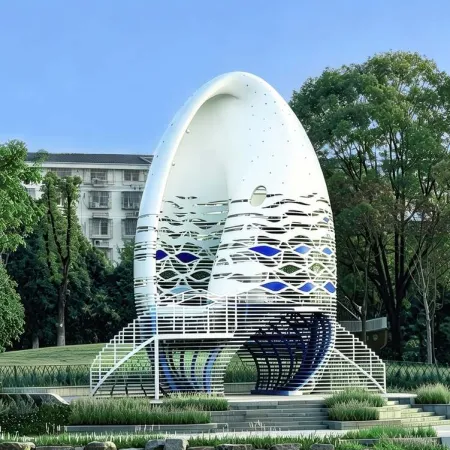
If you are planning art for a landscape, we would be glad to join the conversation early. See works that sit naturally in their settings in our project gallery, review the full service chain on the services overview, and study Weaving Shadows of Fishing Waves, a work whose form and tone were chosen for the ground it occupies.
A landscape sculpture succeeds when nobody can imagine the place without it. That takes a form that suits the ground, a material that suits the climate and a coordination that begins before the first drawing is fixed, which is exactly what landscape sculpture fabrication should provide.