How Outdoor Sculpture Design Survives the Weather That Destroys Lesser Work
Outdoor sculpture design is a contract with the weather, because the work must face sun, rain, frost, salt and wind for decades without losing its form or its finish. The sculptures that fail outdoors rarely fail from weak art; they fail from weak material and structural decisions made in the design room, and the discipline of outdoor work is making those decisions honestly from the first sketch.
Yifeng Sculpture Studio has practised outdoor sculpture design since 2003, with more than 3000 works delivered across 23 countries and climates. From coastal installations facing salt spray to inland works enduring freezing winters, our outdoor designs are engineered for the specific conditions of each site rather than for an imaginary average weather.
Reading the Real Climate of the Site
Outdoor sculpture design begins with the site's actual weather, because the enemies of outdoor work are local rather than general. A coastal plaza brings salt spray and corrosive humidity; a mountain site brings freezing, thawing and intense UV; a desert brings heat, dust and thermal shock; and an urban canyon brings concentrated wind and pollution. The designer must know which enemies the work will face and specify the materials, finishes and drainage to defeat exactly those.
The studio should ask hard questions early, about prevailing winds, flood or splash exposure, de-icing salts, bird pressure and the cleaning regime the owner can provide, because each answer changes the design. A studio that designs outdoor work from a checklist of generic good practice is gambling with the client's money; a studio that designs from the site's real conditions is engineering for a known enemy.
The Weather Tests Every Outdoor Design Must Pass
The table below sets out the principal weather challenges that outdoor sculpture design must answer, along with the design strategies that keep works standing and beautiful.
| Challenge | What it attacks | Design defence |
|---|---|---|
| Moisture | Corrosion, staining, freeze damage | Drainage, sealed joints, drained cavities |
| Salt | Pitting, crevice and galvanic corrosion | Higher grades, isolation, washable surfaces |
| UV | Paint fading, polymer breakdown | UV-stable coatings, lightfast pigments |
| Wind | Fatigue, overturning, flying debris | Structural analysis, tuned stiffness, sound fixings |
| Thermal change | Expansion stress, coating failure | Movement-tolerant detailing, compatible systems |
Water Is the Quiet Killer
Most outdoor sculpture failures can be traced to water finding a way in and being unable to find a way out. Outdoor sculpture design must therefore obsess over drainage, ensuring that every horizontal surface sheds water, every cavity drains, every joint is sealed against ingress and every interface with the ground is protected from splash and standing moisture. Water that pools, seeps or freezes is water that corrodes, stains and cracks, and the geometry that looks innocent in a render can be a water trap in reality.
The base and the ground interface deserve particular attention, because that is where splash, de-icing salts and standing water concentrate. The work should be raised or detailed so its base does not sit in a puddle, the fixings should be protected and accessible, and the transition between sculpture and ground should be designed to shed water rather than collect it. Clients rarely see these details in proposals, and they are exactly the details that decide whether an outdoor work is still beautiful in twenty years.
Materials, Finishes and Honest Maintenance
- Specify for the site: the metal grade, coating system and finish should be chosen for the site's real chloride, UV and thermal load, not for a generic outdoor label.
- Design for cleaning: surfaces that can be washed simply will be washed; geometry that traps dirt will age faster than its materials deserve.
- Plan the coating life: painted works have a recoating cycle, and the design and specification should state it so the owner can budget for it.
- Proof before you build: where the finish matters, sample panels exposed to the real site confirm colour and weathering before full production.
Honesty about maintenance is part of responsible outdoor sculpture design, because a finish chosen for beauty alone will become a burden, while one matched to a realistic care regime will keep its promise.
Engineering the Work Against Wind and Time
Outdoor sculpture design must also engineer for the forces that weather brings. The structure is analysed for wind load and, where relevant, dynamic response; the foundations are designed for the ground conditions and the overturning forces; the fixings are chosen for fatigue as well as strength; and the whole is detailed to tolerate thermal movement without distress. These calculations are not bureaucratic formalities; they are the difference between a landmark that stands for generations and a sculpture that becomes an insurance claim.
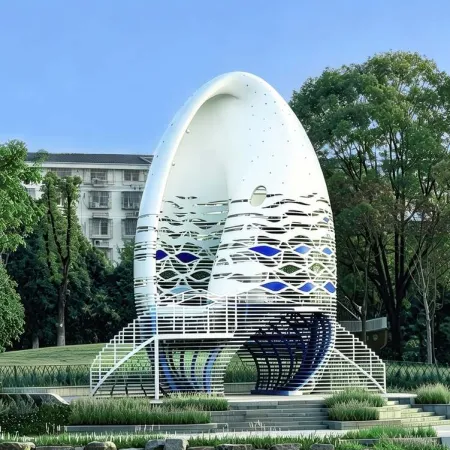
See how our outdoor works have weathered their climates in our project gallery, review the services that support a durable outdoor commission on the services overview, and study Hello Conch, a 12.8-metre interactive shell engineered for continuous outdoor public life beside the water.
What Durable Outdoor Design Delivers
Materials and finishes matched to the real site climate
Drainage designed so water never finds a home
Structure engineered for wind, frost and time
A maintenance story the owner can actually keep
What to Ask Before Approving an Outdoor Design
Clients commissioning outdoor sculpture design should interrogate the weathering story before approving the concept. Ask what site-specific conditions the design was tested against, how water will drain from every surface, what grade and finish are specified and why, what coating life and cleaning rhythm the owner should expect, and what structural analysis has been done for the site's wind. A studio that answers with documents and samples is designing for decades; one that answers with reassurance is designing for the unveiling.
The finest outdoor works are the ones whose weather resistance is invisible, because the viewer sees only beauty while the engineering works silently beneath it. That invisibility is the signature of outdoor sculpture design done properly, and it is achieved by studios that treat the weather as a design partner rather than an afterthought. When you commission with that discipline, your sculpture will still be welcoming the public long after its first season has become a distant memory.
Lightning, Birds and the Other Outdoor Realities
Outdoor sculpture design must also answer the quieter hazards that public works face, and the professional studio raises them before they become problems. Tall exposed works may need lightning protection that is integrated without compromising the form; open structures may invite birds to perch and nest in ways that stain the surfaces; and trees and planting may drop sap, leaves and shade that change the maintenance story. Each of these realities is manageable when it is designed for, and expensive when it is discovered after installation.
The design should therefore consider the full ecology of the outdoor site. We discuss with clients how the work will be cleaned, what access the maintenance crew will have and which surfaces will need the most care, and we detail the work so that cleaning and protection are practical rather than theoretical. A work that is designed with its real outdoor life in mind, including the birds, the storms and the maintenance ladders, is a work that will stay loved by the people who must care for it, and that practical love is part of what keeps an outdoor sculpture beautiful for decades.
The final protection for an outdoor work is the quality of its documentation, because the people who care for the sculpture in future years need to understand what it is made of and how it should be treated. We hand over a care file with every outdoor commission, naming the materials, the finishes, the cleaning methods and the signs of wear that matter, so the owner's team can keep the work healthy without guesswork and without calling in specialists for every small question.
Frequently Asked Questions About Outdoor Sculpture Design
What is outdoor sculpture design?
The discipline of designing sculpture for open-air life, engineering materials, drainage, structure and finishes against the real climate of the site.
Which materials last longest outdoors?
Stainless steel, weathering steel and bronze are the most proven, with the specific grade and finish matched to the chloride, UV and thermal load of the site.
Why do outdoor sculptures stain or rust?
Usually from water management failures or mismatched grades; proper drainage, sealing and corrosion design prevent most outdoor failures at the drawing stage.
How much maintenance does an outdoor sculpture need?
It depends on material and exposure; the design should match finishes to a realistic regime and hand over a clear cleaning and recoating schedule.
Can I see how my finish will weather before building?
Yes, sample panels finished in the specified system can be exposed at the real site to confirm colour and weathering behaviour before full production.
Outdoor sculpture design is a promise to the weather that the work will still be beautiful when lesser pieces have failed, and that promise is kept through site-specific materials, obsessive drainage and honest engineering. Choose a studio that designs for your real climate and tells you the maintenance truth, and your outdoor sculpture will age with grace rather than regret.
If your site is ready for a work that must face the elements, tell us about the place and its weather, and we will show you what outdoor sculpture design can make that will last.