Designing an Architectural Bronze Sculpture: Casting, Patina and Placement
An architectural bronze sculpture is a bronze artwork commissioned for a building or public space, valued for a material that has anchored civic architecture for centuries. Bronze brings warmth, permanence and a living surface that changes with light and weather, and when it is designed as part of a building scheme it carries a gravitas that few contemporary materials can imitate. In our studio we treat bronze commissions with a longer planning horizon than almost any other material, because the decisions made at the wax stage will still be visible a century later.
The tradition of bronze in architecture runs from the doors of ancient cathedrals to the monument portals and sculptural details of modern civic buildings. Clients are drawn to it for reasons that are partly rational and partly emotional: the metal records the artist's touch with unmatched fidelity, it develops a dignified character as it ages, and it signals that the building owner intended something permanent. Those same qualities are why a bronze commission demands a studio that understands both sculpture and structure, rather than a workshop that only pours metal.
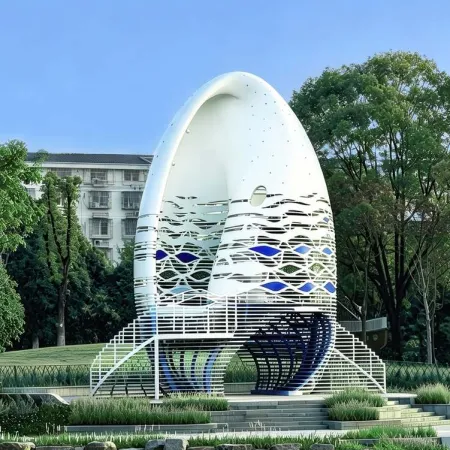
When a client approaches Yifeng Sculpture Studio with a bronze project, we begin with the same disciplined route used on every commission: consultation, concept development, fabrication and installation, all outlined on our services overview with past work documented in our project archive. The structural and installation engineering that lets a large landmark such as Hello Conch stand safely in a public space is the same discipline we apply to bronze sculpture, where weight, wind and foundations all demand respect.
Why Bronze Endures in Architectural Settings
Bronze is an alloy of copper and tin, usually with small additions that tune its color, fluidity and corrosion behavior. In architectural work it is prized for three properties: it casts with exceptional detail, it withstands outdoor exposure for generations, and it ages gracefully. Where stainless steel stays essentially unchanged, bronze slowly develops a patina, and a well-designed bronze surface can become more beautiful in year twenty than it was on the day of installation.
- Detail capture: molten bronze reproduces the finest modeling from the original sculpture, preserving gesture and texture that coarser processes would lose.
- Structural mass: bronze is heavy and strong, which suits monumental work but makes foundations, lifting and wall mounting serious engineering questions.
- Living surface: the metal responds to its environment, and architects can choose between a controlled patina and a natural one that evolves over time.
- Repair history: bronze can be welded, patched and re-patinated decades after installation, which protects the client's long-term investment.
The Making of an Architectural Bronze Sculpture
Every architectural bronze sculpture begins as a concept model, usually in clay or digital form, which is then scaled up with care. For large commissions we work section by section: the full-size sculpture is divided into manageable castings, each piece is cast, chased and welded into the whole, and the seams are finished so the assembly reads as a single continuous form. The chasing stage, where skilled hands refine the raw casting, is where most of the quality in a bronze is won or lost.
Patina is the chemist's contribution to the sculptor's work. Through controlled application of chemicals and heat, we create the browns, greens and blacks that give bronze its character, and we protect the result with a wax or lacquer appropriate to the climate. Outdoor architectural bronze in a wet or coastal region needs a different protection strategy than an indoor lobby piece, and we confirm the environmental assumptions with the client before fixing a finish specification.
Mounting an architectural bronze sculpture is a structural operation. The piece must be anchored against wind loads, seismic forces where applicable, and the simple weight of the metal itself. Internal stainless steel armatures are commonly used to carry the load, with bronze sections fitted over them so the visible surface remains true to the artist's form. Our engineers calculate the supporting structure and produce documentation that the project's structural engineer and the local reviewer can verify.
Planning, Budget and Timeline for Bronze Commissions
Bronze is not a material for a rushed schedule. The casting process alone, from approved model to finished metal, runs through many stages that cannot be compressed safely: mold-making, wax, shell building, pouring, cooling, chasing, patina and protection. Clients who plan a bronze commission around an opening date usually succeed by working backwards from that date with the studio and building in review gates rather than assuming the foundry will catch up.
Budget expectations follow the same logic. The value in bronze sits in the modeling, the chasing and the patina, so the largest line items are skilled labor and the number of casting sections rather than the raw metal. We are transparent about how a quotation is built, and we never pretend that a complex figurative commission can be delivered at the cost of a simple abstract form. What we can promise is a fixed, itemized proposal with no surprises buried in the small print.
| Consideration | Bronze in architecture | How we handle it |
|---|---|---|
| Weight | High; foundations must be engineered | Structural design with your engineer |
| Surface | Patina evolves; needs specification | Controlled or natural patina agreed up front |
| Timeline | Longer than welded metal processes | Schedule built backwards from opening |
| Maintenance | Periodic cleaning and wax renewal | Schedule and service support provided |
We also encourage clients to keep a small archive of the approved surface treatment. Bronze color can be specified in many directions, from a bright golden brown to a deep near-black green, and the only way to be certain the production piece matches the approved direction is to lock the reference samples during development. Those samples also become the standard for any future repair or re-patinating work, which protects the client's asset long after the original project team has moved on to other buildings. In our experience the clients who treat the sample approval as a real decision point, rather than a formality, are the ones who are happiest with the finished commission ten years later.
Bronze in Different Climates
The same architectural bronze sculpture behaves differently in a dry desert city, a humid coastal town and a cold northern climate, and the design should be tuned accordingly. In humid or marine environments we pay close attention to drainage so water never sits in crevices, and we may recommend a protected patina with periodic renewal. Where the air is clean and dry, a natural patina can be left to develop slowly with minimal intervention.
We ask every client for honest site information before we quote: coastal proximity, prevailing weather, pollution levels and whether the piece will be touched by the public. These details shape the alloy choice, the surface protection and the maintenance schedule, and getting them right at the start avoids expensive corrections after installation. This site-first habit is one of the reasons our installed works, across more than twenty countries since 2003, have kept their character.
The Casting and Finishing Sequence Behind Our Bronze Work
- Pattern and mold preparation from the approved scale model
- Casting, followed by weld dressing and surface blending
- Patina application and color approval with the client
- Protective coating, final inspection and documentation
Common Questions About an Architectural Bronze Sculpture Commission
Can you match bronze to our existing building palette?
Bronze alloys and patinas offer a wide color range, from golden and reddish browns to deep greens and near-black, so we can develop samples until the tone sits comfortably beside your stone, glass or metal facade.
Do you work from an architect's design or a commissioned artist?
Both. We cast and fabricate works designed by external artists as well as works developed inside our studio, and we handle the engineering either way.
Is bronze suitable for rooftop or wall-mounted positions?
Yes, with engineered supports. Wall and roof mounts need the same wind and structural analysis as a freestanding monument, which our team provides as part of the package.
How is the bronze surface protected over decades?
The patina is stabilized with protective coatings at the workshop, and every commission leaves with a maintenance schedule covering periodic washing and re-coating. Because the alloy itself is inherently corrosion-resistant, upkeep is routine rather than technical, and we remain available for inspection visits when required.
Can bronze be combined with other materials in one work?
Yes, and we encourage it when the architectural context calls for contrast. Bronze elements are regularly mounted on stainless steel structures or paired with glass and lighting, with isolation details engineered so the different metals do not interact over time.
Few materials carry the weight of history that bronze carries, and few reward careful planning as generously. An architectural bronze sculpture conceived with the building, cast with disciplined craftsmanship and protected with a realistic maintenance plan becomes an asset that outlives every other component of the project. The key is to start the conversation before the schedule hardens and the budget line closes, while there is still room to design the piece properly.
If you are considering bronze for an entrance, a courtyard, a lobby or a memorial element, send us your concept sketches and site information. Our studio will advise honestly on casting strategy, patina direction and program, so you can decide with confidence whether an architectural bronze sculpture is right for your site. Get in touch and let us put a bronze specialist on your project.