What a Large Sculpture Fabricator Must Prove Before Your Commission
A large sculpture fabricator is the workshop that turns drawings into steel, and for a monumental commission that workshop is the difference between a vision realised and a vision betrayed. Fabrication at scale demands heavy equipment, structural-grade welding, precision forming and finishing craft that no ordinary metal shop can offer, and it demands proof, not promises, before you trust it with a one-off public work. After more than a decade running a studio that designs and fabricates large sculpture in our own workshops across twenty-three countries, I have learned exactly what separates a fabricator you can trust from one who will learn on your budget.
This guide explains the capabilities, the quality controls and the verification steps that a serious large sculpture fabricator must pass.
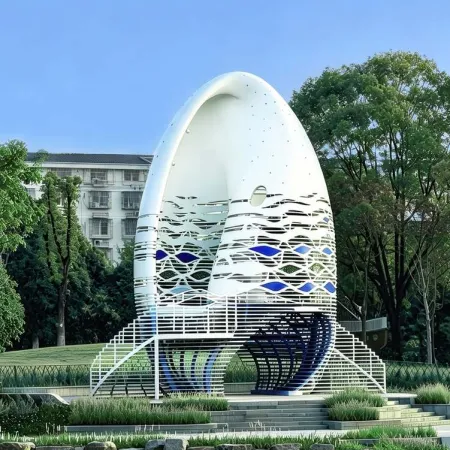
Our fabrication services describe our workshop capabilities, the delivered works archive documents what we have built, and the Honeycomb Pavilion shows complex monumental fabrication realised in our own facility.
Fabrication Is Where Sculpture Succeeds or Fails
Every monumental sculpture must pass through the hands of a large sculpture fabricator, and those hands decide whether the art survives the journey from model to metal. A design can be brilliant in the rendering and ruined in the workshop by sloppy forming, visible welds, distorted planes or finishes that betray the concept, so the fabricator is not a supplier to the artist but a co-author of the final work. The best monumental art is made by fabricators who understand sculpture, who read the intent behind the drawing and who take the same pride in a hidden weld as in a visible surface.
The cost of poor fabrication is catastrophic at monumental scale. A defect that would be a small repair in a two-metre work becomes a major operation in an eight-metre sculpture, requiring cranes, re-fabrication and international shipping if the work has already left the workshop. That is why serious clients verify the fabricator's capacity before committing, because the cheapest quotation from the wrong workshop is always the most expensive choice in the end.
The Workshop Capabilities That Scale Demands
A genuine large sculpture fabricator must possess capabilities that scale with the work. The floor must be large enough and the cranes heavy enough to handle full monumental sections; the equipment must include plate rolling and forming machines that can create the curves of the design; and the welding team must be qualified to structural standards while caring about the appearance of every seam. These are not luxuries but necessities, because a workshop without the capacity for your scale will improvise, and improvisation on a monumental sculpture is where quality goes to die.
The fabricator should also offer the full range of finishing in-house, because handing a monumental surface to an outside polisher or painter breaks the chain of accountability. A mirror finish needs a dedicated polishing team and a clean environment; a painted work needs a controlled coating facility; and the transition between fabrication and finishing is where defects are introduced if the two are separated. One roof for forming, welding and finishing means one standard and one responsible party, which is exactly what a monumental commission requires.
| Capability | Why It Matters | How to Verify |
|---|---|---|
| Heavy capacity | Handling full monumental sections | Floor and crane inspection |
| Forming equipment | Creating the curves of the design | Machines seen in operation |
| Structural welding | Safety and invisible seams | Certificates and finished welds |
| In-house finishing | One standard for surface quality | Finish samples and facilities |
Engineering: The Fabricator's Hidden Duty
A large sculpture fabricator carries a hidden engineering duty that most clients never see but every client depends on. The fabricator must translate the design into buildable sections, determine the wall thicknesses and internal structure that carry the loads, and ensure that the assembled work stands safely against wind and its own weight. Whether the calculations come from the fabricator's own engineers or from the studio's, the fabricator must understand them well enough to build to them, because a structure that cannot be built as calculated will be improvised in the workshop, and improvisation has no place in public safety.
The fabricator's documentation should be as rigorous as its welding. Structural reports, material certificates, weld inspection records and assembly drawings should all be available to the client, because they are the evidence that the work has been built to a standard. A fabricator that cannot produce documentation is hiding its process, and a monumental sculpture is far too permanent to be built by a workshop that operates in the dark.
Quality Control From First Cut to Final Polish
The quality of a large sculpture fabricator shows in its quality control, and that control must run from the first cut to the final polish. Each stage of fabrication should be checked against the approved design, with geometry verified after forming, welds inspected before finishing and the full assembly proven before disassembly for shipping. The workshop should welcome client inspections at defined milestones, because the client's engineer and the fabricator's team working together catch problems that neither would find alone.
The final assembly test is the most important quality gate of all. Before a monumental sculpture is disassembled, packed and shipped across the world, it should be fully assembled in the workshop and checked for fit, alignment and finish, because any problem found at that moment is a workshop problem, while any problem found on site is an international crisis. We always prove the complete assembly before shipping, and we recommend that every client of every large sculpture fabricator insist on the same proof.
Choosing a Fabricator: The Verification Checklist
Before committing to a large sculpture fabricator, run a verification that goes beyond the quotation. Visit the workshop or demand a live video tour, and compare what you see with what the marketing promises; ask to see work of similar scale and complexity that the same team has completed, not work borrowed from other companies; and request the names of engineers and welders who will personally carry your project. A fabricator that opens its floor, names its people and shows its records is demonstrating the confidence that only genuine capability provides.
- Walk the floor: confirm capacity, equipment and real activity
- See similar work: demand delivered projects at your scale
- Demand documentation: engineering and weld records on request
- Insist on a dry fit: prove the full assembly before shipping
A Trustworthy Fabricator Will Show You
Its workshop at work, not just in photographs
Delivered projects at your own scale
Engineering and weld documentation
A full assembly proof before packing
When Fabrication and Design Live Under One Roof
The strongest arrangement for a monumental commission is a studio where the designers and the large sculpture fabricator are the same organisation, because that removes the handoff where so much quality is lost. When the sculptors can walk to the workshop and discuss a detail with the welders before it is cut, when the engineers can adjust a design in response to a forming reality, and when the finishing team can ask the artist about the exact quality of a surface, the sculpture is protected at every step. We built our studio on that model, and it is the reason our delivered works match our approved designs so faithfully.
Since 2003 our studio has designed and fabricated large sculpture across twenty-three countries, and we invite you to walk our workshops, review our engineering and inspect the delivered works that stand behind our name. A large sculpture fabricator earns trust with evidence, and we would rather show you everything than ask you to believe anything.
Frequently Asked Questions About a Large Sculpture Fabricator
What is the difference between a fabricator and a foundry?
A fabricator works in formed and welded metal such as steel and stainless, while a foundry casts molten metal such as bronze. Many large works combine both, and some studios offer both capabilities.
How do I verify a fabricator can handle my scale?
Visit the workshop or take a live video tour, and compare the floor, cranes and equipment against the demands of your project. Ask to see delivered work of comparable size and complexity.
Should the fabricator also do the engineering?
The fabricator must at minimum build to sound engineering and provide documentation. The strongest arrangement is design, engineering and fabrication under one roof with a single accountable team.
Why is a full assembly test important before shipping?
It proves the sections fit, align and finish correctly before the work is disassembled and sent overseas. Problems found in the workshop are cheap; problems found on site are crises.
Can a fabricator install the work it builds?
Many can, and it is the safest arrangement. A fabricator that sends its own crews to erect the sculpture protects its work through the final and most delicate stage of the journey.
A large sculpture fabricator is the invisible co-author of every monumental work, and choosing the right one is as important as choosing the design itself. Verify the workshop, the people and the records, and your sculpture will be built by hands that honour the art.
Let our studio and workshop prove what a large sculpture fabricator can do when craft and art are held to the same standard.