How Modern Public Space Art Speaks the Language of Today
Modern public space art speaks the visual language of today, clean lines, honest materials, bold scale and ideas drawn from the way we actually live, and that is why it connects with contemporary audiences faster than work that borrows the manners of the past. It is not one style; it is a family of approaches that share a commitment to the present, and it gives a city the rare pleasure of seeing its own time reflected back.
Since 2003 our studio has designed and built contemporary public works across 23 countries, and we have watched the definition of modern public space art widen from polished abstraction to include light, interactivity, social commentary and digital life. This guide explains what makes a work feel current, how to commission modern work that still lasts, and why today's language need not mean tomorrow's dated artefact.
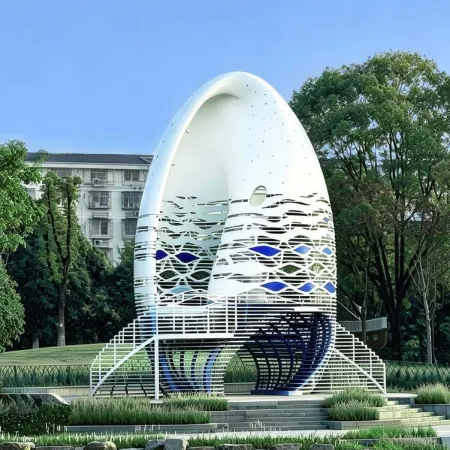
Explore the range in our project gallery, our approach in the services overview and a contemporary interactive piece such as Hello Conch, a 12.8-metre landmark.
The Ingredients of a Modern Public Work
What makes modern public space art feel of its time is rarely a single gesture; it is a combination of choices. The form tends toward clarity rather than ornament, letting structure and silhouette carry the meaning; the material is often used honestly, showing what it is rather than pretending to be something richer; the scale engages with the surrounding city; and the idea, whether poetic, critical or playful, belongs to the present conversation about public life, technology and environment.
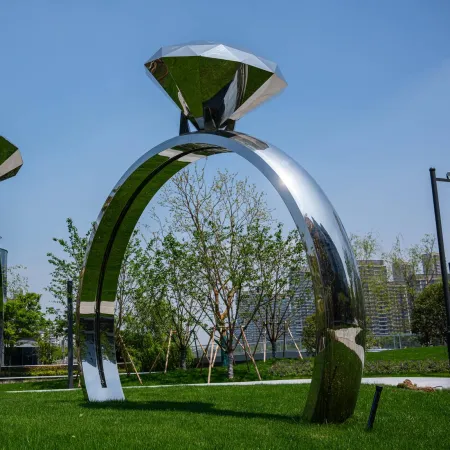
Many of the most successful modern works also borrow the language of their moment without chasing it. An LED installation references digital culture without trying to be a screen; a kinetic piece references machines and wind without imitating either; a mirror-polished form references the viewer's own image. The work stays modern because it translates the present into sculpture rather than copying its surface, and that translation is exactly the artist's job.
Why the Public Often Warms Faster Than the Committee
There is a recurring comedy in public art: the committee agonises over a modern proposal, the local newspaper runs sceptical headlines, and then the public adopts the work within weeks while the committee members quietly take credit. Modern public space art is built to be photographed, shared and lived with, and people who were never asked their opinion often understand it more quickly than the stakeholders who were asked too much. The lesson for commissioners is that public reaction is a poor predictor before installation and a strong validator after it.
We have seen this pattern repeat across our projects, from interactive installations that children adopted as their own to abstract landmarks that residents began using as meeting points and directions. The works that connected were not the ones that played safe; they were the ones that trusted the public's intelligence and offered something to discover. If a proposal makes the committee slightly nervous, that nervousness is often a sign of real content rather than a reason to retreat.
Modern Doesn't Mean Disposable
A common fear is that modern public space art will date quickly, but the works that date are the ones that chased fashion rather than ideas. A form built on a durable concept, the relationship between people and water, the poetry of flight, the rhythm of a community, stays readable long after its surface details have aged, while a work built on a marketing gimmick dies with the gimmick. The client should ask each proposal what idea it carries that will still matter in thirty years.
Physical durability supports conceptual durability. Modern works often use stainless steel, aluminium and engineered glass precisely because those materials hold their finish and their meaning under public conditions, and interactive elements are built to industrial standards with accessible maintenance points. A modern work that is engineered like a monument can still speak like a poem, and the combination is what lets it serve its city for decades rather than for a season.
| Modern approach | What it adds to the space | Design consideration |
|---|---|---|
| Minimal form | Calm and clarity in busy settings | Proportion must be flawless; nothing hides |
| Light and media | Night identity and digital relevance | Plan energy, controls and maintenance access |
| Interactivity | Ownership and daily return visits | Robustness and intuitive discovery matter |
| Honest material | Integrity that ages with dignity | Match finish to climate and cleaning reality |
Commissioning Work That Reflects Your Moment
The brief for modern public space art should ask for the present, not for a vague idea of progress. Describe the place as it is today, the people who use it, the technology they carry, the issues the community cares about, and the feeling the space should carry in the evening as well as the morning. Modern artists respond to honest context, and the more specific the brief, the less likely you are to receive generic contemporary shapes that could stand anywhere.
The selection process should value ideas over images. Ask shortlisted studios to explain the thinking behind their concepts, how the work will behave at different hours, how it will be maintained and what idea it will carry into the future, and judge those answers against your brief rather than against a taste for a particular look. When the reasoning is sound, the look tends to follow, and when only the look is judged, the reasoning is often missing.
What Modern Public Space Art Asks of the Maker
Modern forms place severe demands on the maker precisely because they are simple. A clean silhouette exposes every weld and every tolerance; a mirror surface shows every imperfection; an interactive system must survive the public and the weather; and a light programme must be reliable enough to become part of the city's nightly rhythm. The studio needs both the artistic judgment to design the form and the engineering and fabrication depth to make it flawless at full scale.
This is why we keep design, engineering and fabrication under one roof. The designers who draw a modern form work beside the engineers who analyse it and the welders and polishers who build it, so the concept is tested against reality from the first sketch and the finished work matches the approved vision. A modern public work has nowhere to hide, and a studio that understands that truth is the only safe place to build one.
Signs a Modern Proposal Has Lasting Content
It can be explained in one sentence that does not rely on jargon
It answers something specific about your place and its people
It behaves differently at different hours and seasons
It will still mean something when its surface details have aged
Commissioning Checklist for a Modern Work
- Describe the present of the site and its community in the brief.
- Judge ideas before images in the selection process.
- Ask what the work will mean in thirty years, not only today.
- Plan the night, the maintenance and the interaction from the start.
Helping the Public Meet a Modern Work
Beyond the commissioning itself, the most successful modern works are supported by a deliberate public launch that helps people enter the work's language. A short interpretive story, a conversation with the artist, a school programme that lets young people respond to the form, these inexpensive additions change how a work is received in its first months and set the pattern for its whole life. We have watched the same sculpture be embraced or ignored depending almost entirely on whether anyone helped the public meet it, and we now advise every client to plan that meeting as part of the commission rather than leaving it to chance.
Frequently Asked Questions About Modern Public Space Art
What defines modern public space art?
A family of contemporary approaches, clean form, honest material, bold scale and ideas drawn from present-day life, rather than a single fixed style or a repeat of historical manners.
Will a modern work still feel relevant in thirty years?
If it is built on a durable idea about place and people it will, while work that chases fashion or marketing gimmicks dates with the gimmick.
Why do modern works often win the public faster than committees?
Because they are built to be discovered, photographed and lived with, and the public judges them through daily use rather than through the anxiety of approval.
What materials suit contemporary public commissions?
Stainless steel, aluminium and engineered glass for their honesty and durability, with light, motion and interactive elements where the concept calls for them.
How do I judge between competing modern proposals?
Judge the reasoning against your brief, how each work behaves through the day and seasons, its maintenance reality and the idea it will carry into the future.
Modern public space art gives a city the rare gift of seeing its own time made visible, and when it is built on durable ideas and serious craft it keeps that gift for generations. The best modern works are not the safest or the loudest; they are the truest to their moment and their place.
If you are ready to bring modern public space art to your site, we will start from a conversation about your place as it is today and develop concepts that carry its present into its future.