Why a Landmark Abstract Sculpture Becomes a Place Identity
A landmark abstract sculpture speaks in the language of form, mass, line and light rather than in the language of figures and stories, and that freedom is exactly why abstraction dominates the most memorable civic landmarks of our time. Because nothing literal needs to be depicted, the work can distil a place identity into a single bold gesture that reads from the road, frames the sky and rewards generations of viewers with new readings. I have spent more than a decade creating landmark abstract sculpture for clients across twenty-three countries, and this guide explains why abstract forms carry public identity so powerfully and how to commission one well.
We will look at how abstraction communicates, the forms and materials that endure, the pitfalls of public abstract commissions and the process that turns a gesture into an icon.
Our public project archive shows landmark abstract sculpture in real settings, the design and fabrication services explain how a concept becomes steel, and the Radiant Galaxy installation demonstrates an abstract form built to landmark scale.
How Abstraction Carries Meaning in Public Space
Abstract sculpture communicates through the oldest visual instincts we possess. A vertical form suggests aspiration, a ring suggests unity or continuity, a sphere suggests wholeness, a wave of metal suggests movement and energy, and these readings need no language, no education and no caption. That universality is the secret of the landmark abstract sculpture, because a public landmark must speak to everyone, from the child who sees a playground shape to the architect who reads a structural idea, without excluding anyone through literalism.
Meaning in abstraction is also open, which is a civic strength rather than a weakness. Where a figurative monument fixes one interpretation, an abstract form invites each viewer to complete it, so the sculpture accumulates personal meanings across the community and stays alive as the city changes around it. The finest abstract landmarks are those whose form is precise enough to be memorable yet open enough to be adopted, a balance that requires real artistic discipline rather than random gesture.
Forms That Endure as Landmarks
Certain formal families recur in successful landmark abstract sculpture because they solve the problems of public space with elegance. The arch and the portal frame a view and invite passage; the ring and the torus create interior space and read identically from every angle; the column and the spire claim vertical dominance; the wave and the ribbon carry movement along a plaza; the sphere and the egg concentrate mass; and the constellation scatters related elements across a site. Each family offers different relationships to human scale, to movement and to the surrounding architecture.
| Form Family | Visual Reading | Ideal Setting |
|---|---|---|
| Arch and portal | Frames views, invites passage | Entries and gateways |
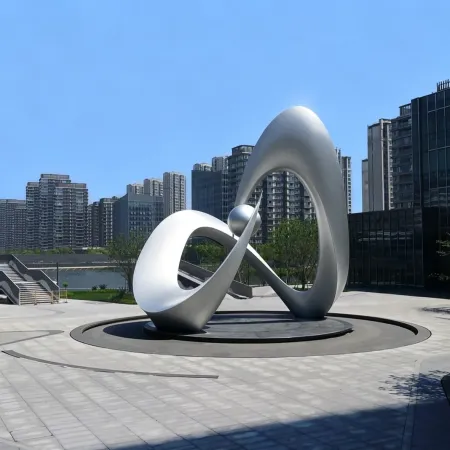
| Ring and torus | Unity, continuity, interior space | Plazas and roundabouts |
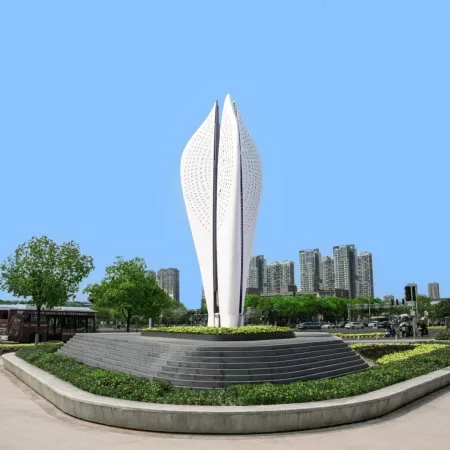
| Column and spire | Aspiration, vertical dominance | Skyline and axial views |
| Wave and ribbon | Movement, flow, energy | Waterfronts and promenades |
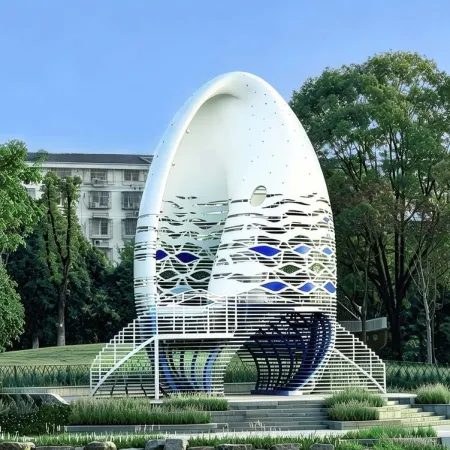
| Sphere and mass | Wholeness, permanence, gravity | Gardens and contemplative sites |
Material as the Carrier of Abstraction
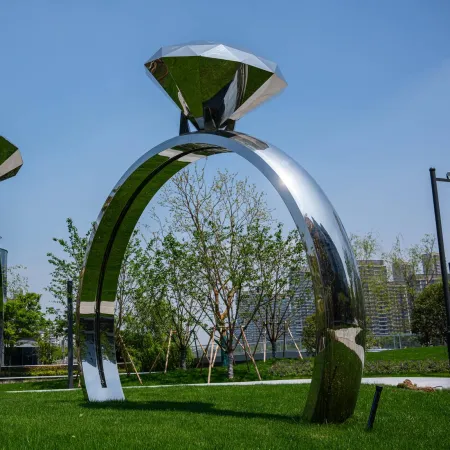
Because an abstract sculpture carries no story in its subject, its material becomes its skin and its voice. Mirror stainless steel dissolves the form into sky and city, letting the environment repaint the sculpture every hour; brushed and painted steel give colour and sculptural weight; weathering steel adds an earthy patina that deepens with time; and bronze brings warmth and a classical permanence. The choice of material is a choice of meaning, and it must also answer the climate, the maintenance budget and the surrounding architecture.
Surface quality is where landmark abstract sculpture lives or dies, because abstraction leaves no figural details to hide behind. A mirror finish must be truly seamless, a paint system must be flawless and durable, and the junctions between fabricated sections must disappear into the form. The difference between a sculpture that looks engineered and one that looks inevitable is measured in hours of hand finishing, and clients should see finish samples at full specification before production rather than trusting photographs of other projects.
Commissioning an Abstract Landmark That Belongs
The commissioning process for landmark abstract sculpture starts with the site and its story, because abstraction still needs roots. The studio should study the place, its scale, its sightlines, its community and its ambitions, then present concept directions that grow from that reading. The concept should be tested at true scale, ideally with a full-size mock-up or a digital model placed in real photographs, because abstraction is unforgiving to scale errors, and what looks elegant in a small model can look trivial or oppressive at thirty metres.
What a Landmark Abstract Sculpture Needs
A form that reads at distance and up close
Material and finish chosen for the climate
Scale tested before fabrication begins
Open meaning the public can adopt
The Common Fears and the Honest Answers
Clients often fear that the public will reject abstract work, yet the evidence of delivered landmarks tells a more interesting story. People resist abstraction when it feels random or imposed, and they embrace it when it feels intentional and crafted, which is why the quality of the concept and its connection to place matter more than the question of figuration. A well-designed abstract sculpture is adopted because it is beautiful and legible, and a weak one is rejected because it is weak, not because it is abstract.
Community engagement is the practical answer to that fear. Presenting the concept early, explaining the thinking behind the form, naming the sculpture through public involvement and showing how it responds to the site all build the ownership that makes a landmark succeed. Since 2003 our studio has delivered landmark abstract sculpture across twenty-three countries, and the works that communities love most are consistently those whose story was shared before their steel was cut.
Abstraction is not an escape from meaning but a concentration of it, and a landmark abstract sculpture distils a place identity into a form that needs no translation. The right concept, engineered honestly and finished obsessively, becomes the image your city carries in its memory.
The Role of the Artist Hand in an Abstract Landmark
Because an abstract sculpture carries no literal subject, the hand of the artist is more visible in it than in any figurative work, and the quality of that hand decides whether the form feels inevitable or arbitrary. The difference between a landmark abstract sculpture that moves a city and one that merely occupies its space is the artist instinct for proportion, rhythm, mass and the interval between forms, qualities that cannot be taught by formula or verified by checklist. When clients choose a studio for an abstract commission, they are choosing that artistic sensibility as much as its engineering, so it is worth studying the abstract works in the portfolio with care and asking which artist would personally develop the concept for your site.
The artistic hand must also be disciplined by the realities of public sculpture, and the strongest abstract landmarks are those where vision and engineering refine each other. The artist pushes the form towards its most expressive possibility; the engineer reveals what the wind, the structure and the foundation will allow; and the dialogue between them produces a work that is both more daring and more durable than either could achieve alone. Clients should expect this dialogue to be visible in the design process, with concepts tested, structures analysed and materials sampled before the form is frozen. When the hand of the artist and the discipline of the engineer work in concert, the landmark abstract sculpture that results is the kind of work a city keeps for generations.
Frequently Asked Questions About Landmark Abstract Sculpture
Will the public understand an abstract sculpture?
Abstraction speaks through universal instincts of form and mass that need no language, and communities embrace abstract landmarks when the concept is strong and its connection to place is explained through early engagement.
What materials suit a large abstract landmark?
Stainless steel, painted steel, weathering steel, bronze and aluminum all serve abstract forms, and the choice depends on the concept, the climate and the maintenance budget. Finishes must be specified for decades of outdoor life.
How is the right scale for an abstract landmark decided?
Scale is tested against the site through full-size mock-ups or realistic visualisations, because abstraction is unforgiving to scale errors. The form must read from approach distances and hold its presence in context.
Can an abstract landmark include lighting or movement?
Yes. Integrated lighting, kinetic elements and water features extend the presence of abstract forms and are engineered into the structure from the start, though they add maintenance responsibilities that should be planned.
How do we brief a studio for an abstract commission?
Share the site, its story, the character you want the place to project and your constraints, then let the studio propose concepts. Strong briefs describe the feeling and ambition rather than prescribing a specific form.
A landmark abstract sculpture is a gift to a place that keeps giving, because its meaning grows as the community grows around it. Commissioned with care, engineered with rigour and finished with obsession, it becomes the silhouette that identifies your place in a single glance.
Share your site with us, and we will show you the landmark abstract sculpture your place has been waiting for.