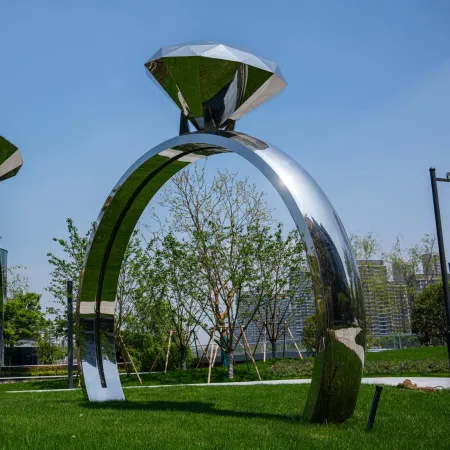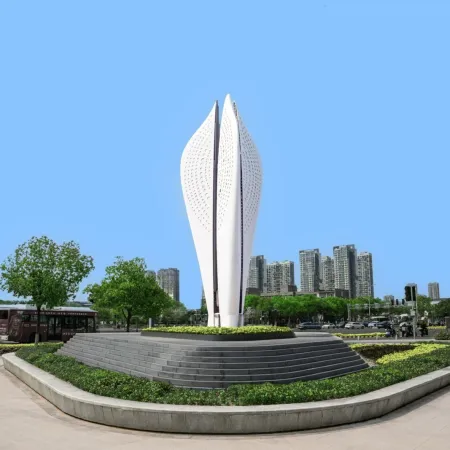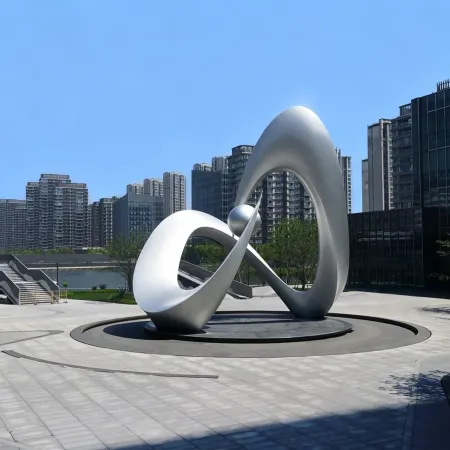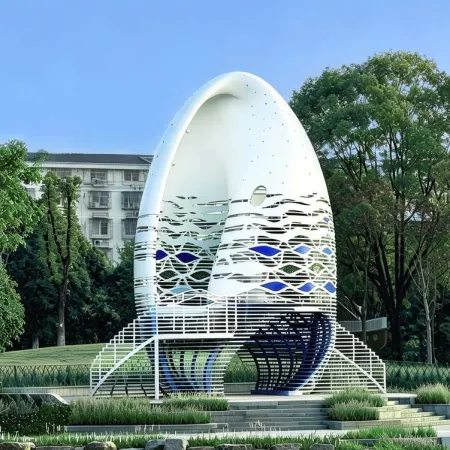
Why a Custom Composite Sculpture Is the Smart Choice for Large Modern Forms
A custom composite sculpture lets designers create forms that would be impossibly heavy, expensive or fragile in traditional materials, which is why so many of the boldest modern commissions for malls, theme parks, lobbies and public spaces are now fabricated in advanced composites. When clients first hear the word composite, they picture boat hulls or industrial parts, yet the same engineering has transformed sculpture making: it allows sweeping organic surfaces, dramatic overhangs and scale that reads like metal while weighing a fraction of the equivalent. From my years of delivering sculptural commissions, I have found composite is the material that makes the previously impossible become buildable, provided the studio understands both the material science and the finishing craft that makes composite read as fine art.
We explain what composite sculpture actually is, where it outperforms metal and stone, how fabrication and finishing work, and the quality questions that protect your project.
Our services overview describes our composite and fabrication capability, the project archive shows large modern commissions we have delivered, and the Fishing Net Canopy case demonstrates the scale of sculptural structure our team engineers.
What Composite Sculpture Material Really Is
In sculpture, composite usually means a fibreglass-reinforced resin system, often described as FRP or GRP: a polymer resin strengthened with glass fibre layers, built up inside or over a mould to create a rigid shell. The material is the same family used in automotive body panels, marine hulls and architectural cladding, but in the hands of a sculpture studio it becomes a medium for pure form. Because the shell can be made relatively thin over an internal structural frame, a composite sculpture can enclose enormous volume without enormous weight. A form that would require thick bronze or welded steel plate can be fabricated in composite and lifted with ordinary equipment. That fundamental advantage, form freedom plus manageable weight, is what drives the material's popularity for contemporary commissions.
Where Composite Beats Metal, Stone and Bronze
Every sculpture material has a territory where it excels, and composite's territory is large, complex, organic or colourful form. Metal is magnificent for precise geometric and polished work but becomes costly when the form demands seamless double curvature. Stone carries mass and permanence but cannot float or overhang without heavy structure. Bronze is peerless for fine figurative detail but expensive at architectural scale. Composite, by contrast, can produce smooth continuous surfaces in almost any shape, then receive a finish that mimics painted metal, stone or a custom colour scheme. It is also the practical choice when a work must be installed on a rooftop, suspended overhead or positioned where structural loading is limited. Designers who need a twelve-metre swirling ribbon or a giant character figure usually find composite is the only material that delivers the vision within the structural budget.
| Material | Strength | Limitation |
|---|---|---|
| Composite FRP | Freeform surfaces, low weight, colour range | Finish must be engineered for outdoor life |
| Stainless steel | Polished mirror, structural permanence | Expensive for complex double curvature |
| Bronze | Fine detail, timeless patina | Heavy and costly at large scale |
| Stone | Mass, permanence, natural texture | Limited overhang, transport weight |
How a Composite Sculpture Is Engineered and Built
Serious composite sculpture is engineering as much as artistry. The design begins with the form, but the internal structure must be calculated: a steel armature carries the loads, the composite shell provides the surface, and the two are designed together so the work stands safely under its own weight, wind load and any public interaction. Fabrication typically proceeds by creating the surface in sections, laminating the composite layers, then joining and fairing the sections into one continuous skin. The skill shows in the seams: a poorly joined composite sculpture reveals its section lines, while a well-made one reads as a single unbroken form. After the shell is complete, the surface is prepared and finished, often with an automotive-grade paint system or a gel coat that provides both colour and weather protection.
Finishing: The Secret to Composite That Lasts Outdoors
The question clients ask most often about composite is whether it survives outdoor life, and the honest answer is that durability is decided by the finish system and the lamination quality, not by the material alone. Composite can serve outdoors for decades when the resin system is chosen for the climate, the gel coat or paint is UV-stable, and the edges and fixings are detailed so water cannot find its way in. It can also fail quickly when cheap resins and thin finishes are used. That is why the studio's specification discipline matters more than the material choice itself. A responsible fabricator documents the resin system, the UV protection and the maintenance recommendation, and stands behind the work with guidance that keeps the finish performing. Ask any composite studio exactly how the surface will be protected and what the maintenance expectation is for your climate.
- UV-stable finishing: the colour system must resist sun fading for years
- Water detailing: edges, drains and fixings designed so moisture cannot intrude
- Structural armature: internal steel engineered for wind and live load
- Seamless skin: sections joined and faired until the surface reads as one form
Design Freedom and the Approval Process
Because composite fabrication starts from a sculpted or digitally modelled original, the design freedom is exceptional. A custom composite sculpture can replicate a hand-sculpted clay form, follow a parametric surface generated in 3D software, or combine both approaches. The design process should give the client clear visualisations, an approval gate on the form and colour, and a sample panel showing the actual finish before full production. As with any custom work, changes are far cheaper at the modelling stage than after lamination begins, so a good studio invests in getting the digital or physical model right. We typically walk clients through form development, colour samples and structural confirmation before any mould work starts, so the sculpture that arrives on site is the sculpture they approved.
Signs of a Serious Composite Studio
Designs the steel armature and shell together
Specifies the resin and UV system in writing
Provides colour and finish samples before production
Explains outdoor maintenance expectations honestly
Composite With Integrated Lighting and Interactivity
Composite sculpture has a hidden advantage that designers increasingly exploit: it can carry integrated lighting, sound and interactive technology more easily than solid materials. Because the shell is built around an internal structure, there is natural space for lighting components, wiring and access panels, and the material can be specified translucent so light glows through the surface itself. A custom composite sculpture can become a lantern at night, change colour with the seasons or respond to movement and touch, and these effects are engineered into the form rather than bolted on afterwards. For commercial clients seeking a memorable presence, this integration is often what turns a sculpture into a destination.
The engineering of an illuminated composite work deserves the same seriousness as the form itself. Lighting components must be specified for outdoor life where the piece is exterior, access must be designed so lamps and drivers can be serviced, and the electrical installation must meet the site standards. The translucent areas of the shell must be built to the right thickness so the light glows evenly, and the colour and intensity should be tested on samples before the full surface is committed. We develop these details as part of the design stage, because retrofitting lighting into a finished sculpture is costly and rarely satisfies. When the light is designed into the composite from the beginning, the result is a work that changes character completely after dark and keeps performing for years.
Frequently Asked Questions About Custom Composite Sculpture
How long will a composite sculpture last outdoors?
With the correct resin system, UV-stable finishing and proper detailing, a composite sculpture can serve outdoors for decades. Its life depends far more on the specification and workmanship than on the material itself, which is why the studio's discipline matters.
Can composite imitate the look of metal or stone?
Yes. Skilled finishing can make composite read convincingly as painted metal, aged bronze or even stone. The advantage is that you get the look at a fraction of the weight and often of the cost, with custom colour options the original material cannot offer.
Is composite suitable for children's play areas and public interaction?
With a robust structural design, safe edge detailing and non-toxic finishes, composite is widely used in family and theme environments. The internal armature and fixing design must be engineered for the specific interaction, which is standard practice in serious studios.
What is the maximum size achievable in composite?
Composite is typically built in sections and assembled on site, so the practical limit is set by transport and installation rather than by the material. Works of fifteen metres and beyond are achievable when the sections are engineered for joining and erection.
How does composite compare in cost with metal or bronze?
For large complex forms, composite is usually significantly more economical than welded metal or cast bronze because mould-based fabrication and lighter structure reduce both production and installation cost. The exact comparison depends on form, scale and finish specification.
A custom composite sculpture is the material answer to the question designers keep asking, how to build the bold idea without the impossible weight or cost, and a studio that masters both the engineering and the finish makes that answer reliable. Since 2003 our studio has delivered large-scale sculptural commissions across twenty-three countries, combining composite, metal and interactive technologies under one roof so the material is always chosen for the idea, not the other way around. We engineer the structure, build the form and finish the surface to the standard your setting deserves.
If your next project is a form that feels impossible in traditional materials, send us the concept and the site conditions, and we will show you how a custom composite sculpture turns that impossibility into a buildable, installable reality.