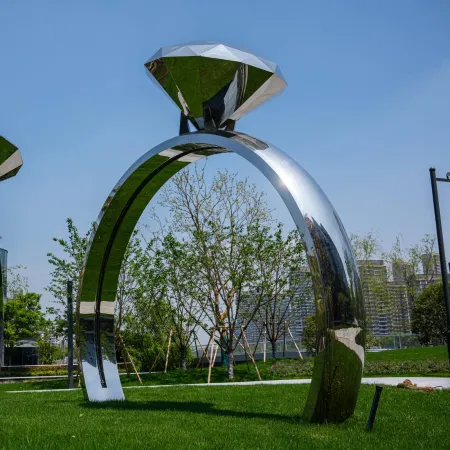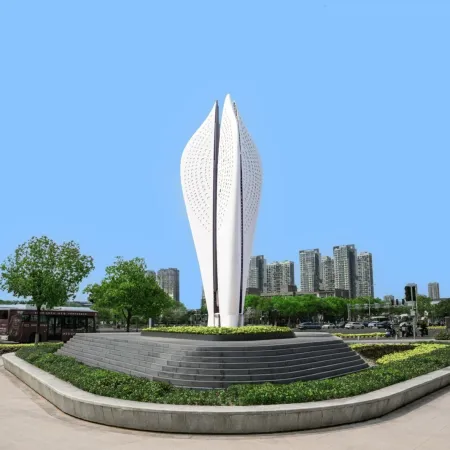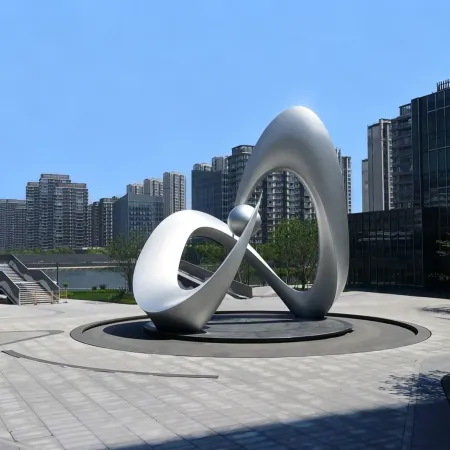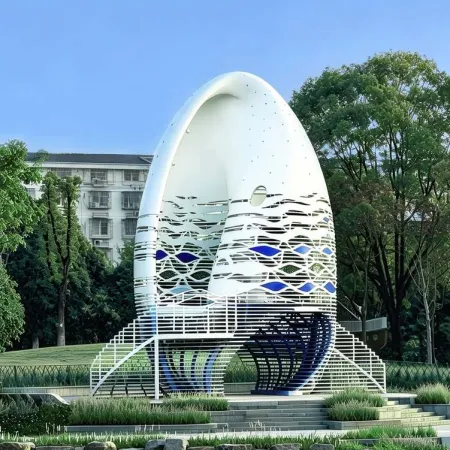
What a Large Scale Landmark Sculpture Demands Beyond Size
A large scale landmark sculpture is not a small sculpture made bigger, because size changes everything: the engineering, the materials, the fabrication, the transport, the installation and even the artistic composition obey different rules when a work must command a highway interchange or a waterfront from a height of twenty metres. The sculptures that succeed at that scale are conceived large from the first sketch, not scaled up from a studio model, and they demand a studio that thinks naturally in civic dimensions. I have spent more than a decade creating large scale landmark sculpture for clients across twenty-three countries, and this guide explains what size really demands.
We will look at how scale transforms design, the engineering of very large forms and the logistics of building and placing a work measured in tens of metres.
Our large work archive documents monumental commissions, the engineering and fabrication services cover the full process, and the Honeycomb Pavilion installation shows a large-scale form engineered as architecture as much as sculpture.
Why Size Changes the Art Itself
Composition at landmark scale obeys different laws than composition at gallery scale. A large scale landmark sculpture is read from hundreds of metres, from vehicles moving at speed and from buildings that overlook it, so its silhouette must be simple enough to grasp in an instant, its internal detail must be scaled to be visible from the viewing distances and its voids must be as carefully composed as its masses. Forms that look elegant in a small model can become fussy or thin when enlarged, which is why the concept must be conceived at true scale from the beginning.
Scale also changes the relationship with the viewer. A small sculpture is looked at; a large scale landmark is walked around, walked under and lived within, and the experience of the work includes the space it frames, the shadows it casts and the sky it claims. The strongest large works create experiences rather than images, inviting the public to enter their scale, feel their mass and discover the world framed through their forms. Designing that experience, rather than merely enlarging a shape, is the true art of monumental sculpture.
The Engineering of Very Large Forms
Engineering a large scale landmark sculpture is closer to bridge design than to studio sculpture, because wind, weight and dynamics dominate every decision. The wind load on a twenty-metre form is enormous and must be calculated for the exact site exposure; the structure must be analysed for stress and for resonance, since large slender forms can be excited into motion by the wind; and the foundation must resist overturning from a structure whose leverage grows with every metre of height. The engineering report for a large landmark is a serious document, and it should exist before fabrication begins.
| Challenge | Why Scale Magnifies It | Engineering Response |
|---|---|---|
| Wind load | Force grows with height and area | Site-specific load calculation |
| Resonance | Slender forms can vibrate in wind | Dynamic analysis and damping |
| Overturning | Leverage grows with every metre | Massive engineered foundations |
| Fatigue | Decades of wind and vibration | Detail design against fatigue |
Fabrication and the Section Problem
No large scale landmark sculpture is built whole, because no workshop, truck or crane can handle a single twenty-metre form. The work is designed from the start as a system of sections, each fabricated within the workshop limits, each transportable by road or sea and each engineered to be assembled on site into a seamless whole. The section boundaries are placed where they can be hidden, the weld and finish plan anticipates the field joints, and the geometry is controlled so that sections that have never been together still meet perfectly at the site. This discipline is called buildability, and it is a mark of a studio that truly works at scale.
Transport of monumental sections is an engineering project in itself. Each piece must be braced against the forces of shipping, protected against damage and checked against the route, with bridges, tunnels, weight limits and turning radii surveyed before the truck departs. For the largest works, sections may travel by sea on flat racks or by specialised heavy transport, and the delivery plan must account for every obstacle between the workshop and the site. A studio that has shipped monumental work internationally has solved these problems before and knows the questions to ask.
- Buildability: designed as sections from the first sketch
- Field joints: seams placed where they can be hidden
- Transport: routes surveyed for every section
- Assembly: site erection engineered like the workshop
Installing a Work Measured in Tens of Metres
The installation of a large scale landmark sculpture is a heavy construction operation, with cranes chosen for the weight and reach of every lift, the sequence planned so that each section stabilises the structure as it is added, and the alignment verified with survey instruments as the work grows. The site must accommodate the crane, the delivery vehicles and the assembly area, and the work is often erected in a public place where the operation must be planned around traffic, crowds and safety. The erection plan is engineered before the first section arrives, and the crew rehearses the sequence so that surprises are handled before they become crises.
Signs of a Studio That Thinks at Landmark Scale
Concepts conceived large from the first sketch
Engineering documents for delivered large works
Fabrication capacity for monumental sections
Proven heavy transport and site erection
Commissioning Monumental Work With Both Eyes Open
Commissioning a large scale landmark sculpture is a major civic investment, and the process should carry the seriousness of infrastructure. The client should verify the studio large work record, review the engineering approach and see how previous monumental commissions were fabricated and installed. The concept should be tested at scale, the engineering completed before fabrication, the fabrication inspected at milestones and the installation planned with the site authority. Because the stakes are enormous, the documentation, the approvals and the inspection regime should be written into the contract from the start.
Since 2003 our studio has designed, engineered and installed large scale landmark sculpture across twenty-three countries, from monumental gateway forms to civic pavilions. We think in sections and tens of metres, we engineer every work for its site and we deliver monumental commissions with the discipline they demand.
A large scale landmark sculpture is one of the grandest gestures a community can make, a form that claims the sky and defines the approach to a place for generations. Conceived at true scale, engineered with rigour and built with buildability in mind, it becomes the image that announces your place to the world.
The Site Survey and the Ground Beneath the Icon
Every large scale landmark sculpture stands on ground that must be understood before the design is finalised, and the site survey is the quiet beginning of every monumental commission. The soil conditions determine the foundation design, and a sculpture that was engineered for rock cannot be assumed to stand on soft fill without a different foundation; the underground services must be located so that the excavation does not sever a cable or a pipe; and the access for the cranes and the deliveries must be verified so that the installation is possible at all. The survey answers these questions early, when the answers can still shape the design, and a studio that commissions a proper site survey before the concept is frozen is protecting the project from the most expensive kind of surprise.
The ground also carries the visual life of the landmark, because the sculpture is seen against its site from every approach. The survey should therefore include the sightlines, the surrounding buildings, the planting that will grow and the viewpoints from which the work will be photographed and judged. The design should be tested against these realities, with visualisations that place the proposed form in the actual setting, so that the client can see how the landmark will read before a single section is fabricated. A large scale landmark sculpture that is designed in dialogue with its ground, both the soil beneath it and the views around it, is a work that belongs to its place from the moment it is conceived, and that belonging is the foundation of its future as an icon.
Frequently Asked Questions About Large Scale Landmark Sculpture
How large can a landmark sculpture be?
There is no fixed limit; works of ten, twenty or even more metres are built when the site and the engineering justify them. The practical limits are set by wind, foundations, transport and fabrication capacity.
Is a very large sculpture more expensive per metre?
Large works carry higher engineering, transport and installation costs, and the relationship is not linear. The studio should scope the full cost of structure, sections, logistics and erection before fabrication begins.
How is a monumental sculpture transported to its site?
The work is built in transportable sections, braced and protected for shipping, and moved by road, sea or heavy transport with the route surveyed in advance. Sections are assembled on site into the finished whole.
What foundation does a very large landmark need?
A foundation engineered for the wind load, weight and overturning moment of the specific design, sized to the ground conditions and set with anchor bolts to tight tolerances. The foundation is designed with the sculpture as one system.
How do we judge the design at true scale?
Through realistic visualisation in the actual setting, scale models studied from the real viewing distances and, where justified, a full-size test element. The studio should test the silhouette before committing to fabrication.
A large scale landmark sculpture is a declaration that a place believes in its future, and it demands partners who think in the same dimensions as the ambition. Choose a studio that conceives at true scale, engineers with rigour and builds with buildability, and your monumental vision will rise as it was drawn.
Bring us your most ambitious site and your boldest vision, and we will show you what a large scale landmark sculpture can become when it is conceived, engineered and built at full scale.