How a Geometric Stainless Steel Sculpture Holds Its Precision
A geometric stainless steel sculpture is judged on precision, because geometry has no place to hide. A cube that is a few millimetres out of square, a curved shell with a shallow flat spot or a row of panels whose reflections do not line up will all be read instantly as defects. Where an organic form forgives small deviations, a geometric one amplifies them, and that means the tolerance discipline in the workshop decides the finished result before any polishing begins.
Yifeng Sculpture Studio has fabricated geometric and abstract stainless work since 2003 among more than 3000 pieces delivered to 23 countries, and we treat these projects as engineering exercises as much as sculptural ones. The design intent is a set of dimensions and a reflection behaviour, and both have to be achieved at full scale in a workshop where heat, handling and gravity all work against them. The process that achieves it is not complicated, but it is unforgiving of shortcuts.
Flatness, Squareness and the Reflection Test
For a geometric stainless steel sculpture, the governing tolerance is usually not the dimension but the flatness and the squareness. A large panel can be cut to the right size and still be dished by a few millimetres, and on a polished surface that dish becomes a visible distortion of everything it reflects. We check flatness with straight edges and with light, and we check squareness with diagonal measurement on every assembly, because a rectangle that is out of square cannot be corrected later by adjusting the neighbouring panels.
The reflection test is the final arbiter. Standing a straight edge or a grid in front of a polished surface shows every deviation, and it is the check we use before signing off a visible face. Because reflections amplify, we set our internal tolerance tighter than the drawing requires, so that the delivered work has margin. Where a design calls for extreme precision, we also consider whether the geometry should be assembled in a jig and left there until it is dimensionally stable, rather than being released as soon as the welds cool.
| Tolerance | Why it is critical | How it is controlled |
|---|---|---|
| Panel flatness | Reflections reveal every dish and ripple | Stiffening ribs, controlled welding, straight edge checks |
| Squareness | Errors compound across an assembly | Diagonal measurement, jigs, assembly before release |
| Seam alignment | A visible offset reads as poor workmanship | Joint preparation, controlled fit up, dressed and blended |
| Edge sharpness | Soft edges destroy the geometry | Machined or formed edges, protected during handling |
| Overall dimension | Must match the foundation and the site setting out | Dimensional inspection against approved drawings |
Controlling Distortion in a Geometric Stainless Steel Sculpture
Stainless steel moves when it is welded, and in a geometric assembly those movements have nowhere to go. A long seam pulls the panels toward each other as it cools, a sharp corner concentrates heat and distorts the adjacent flat, and a thin panel can bow simply from the stress of being handled. The countermeasures are structural and procedural: adequate thickness and stiffening so the panel resists distortion, a welding sequence that balances heat around the section, and restraint in jigs where the geometry must not move.
Surface protection is the other half of precision, because a perfectly made panel can be ruined by a careless lift. We film visible faces as soon as they are finished, handle them with clean gloves, separate them with soft packing and never stack them face to face. On site the same discipline continues, since a geometric stainless steel sculpture can lose its crispness in an afternoon if the installation crew drags a panel across a scaffold. Precision is not only a manufacturing achievement; it is a chain of care that runs from the workshop to the final bolt.
- Stiffness before beauty: ribs, returns and thickness chosen so the panel holds its plane under its own stresses.
- Balanced welding: sequences that distribute heat around the assembly rather than concentrating it in one seam.
- Jigged assembly: geometry restrained until it is dimensionally stable, then measured before release.
- Measured inspection: flatness, squareness and overall dimensions recorded against the drawings.
- Protected handling: film, gloves and packing that keep a finished face as it left the bench.
Precision in Practice
Flatness checked with straight edges and reflected light
Squareness verified by diagonal measurement every time
Internal tolerances set tighter than the drawings demand
Protection maintained from bench to final fixing
Finishing Geometry Without Softening It
Finishing a geometric work requires a different touch from finishing an organic one. The aim is to preserve the edges and the planes while removing the marks left by making, which means dressing welds without grinding a hollow into the flat around them and polishing without rounding the corner that defines the form. Abrasive work on a flat panel must be kept even and directional, and the sequence must be consistent so that no area receives more material removal than its neighbours.
The finish choice changes the difficulty. A brushed surface is more forgiving because the grain disguises small deviations, while a mirror surface exposes everything and is the most demanding. A blasted finish removes reflections altogether and can make even a slightly imperfect flat read as acceptable, which is why it is often chosen for large geometric works that must be built to a realistic tolerance. We discuss that trade off openly with clients, because choosing a mirror finish on an ambitious geometry is a decision with real consequences.
- Dress without hollowing: welds blended into the plane rather than ground into a dip beside them.
- Keep the edges: abrasives controlled so the crisp line that defines the geometry is never rounded off.
- Even removal: a consistent abrasive sequence so no panel loses more material than its neighbour.
- Choose the finish knowingly: mirror for maximum effect and maximum risk, brushed or blasted for tolerance.
- Final reflection review: the whole assembly checked as one composition before it leaves the workshop.
Transport and Assembly of a Geometric Stainless Steel Sculpture
A geometric work must be divided for transport, and the division is a design decision rather than a logistical afterthought. The sections have to be small enough to travel on the available vehicles and pass any restrictions on the route, strong enough to be lifted without distortion and designed so that the joints can be aligned accurately on site. Where the geometry is visible and precise, joints must be positioned where a slight seam will not interrupt a plane or an edge.
Assembly on site needs the same discipline as the workshop. Alignment features such as dowels, spigots or machined faces allow the sections to be brought together in the correct position without relying on field adjustment, and temporary bracing holds the geometry until the permanent connections are complete. Where a geometric stainless steel sculpture is assembled in the open, wind can move large panels, so the sequence must consider the stability of partially completed sections.
Protection during transport and assembly is critical for a geometric work, because a single contact mark on a flat polished panel is difficult to disguise. Finished faces are filmed, panels are separated with soft packing and the installation crew is briefed on how to handle and lift the sections. On site the same care continues, with protective materials kept in place until the last possible moment and finished surfaces never used as a working platform.
Once assembled, the geometry is verified. Dimensions are checked against the drawings, the joints are inspected and the reflections are reviewed as a whole rather than panel by panel, because a geometric stainless steel sculpture is judged as one composition. Any correction is made before the final fixings are tightened and the protection removed, so the client receives a work that is dimensionally sound and visually complete.
Frequently Asked Questions About Geometric Stainless Steel Sculpture
Can you achieve a perfect mirror on a large flat panel?
Very close to it, provided the panel is stiff enough and the welding is balanced, but perfection at large size is limited by the flatness of the plate itself and by how the assembly is restrained.
How thick should the steel be?
Thickness is driven by the span between supports and by the flatness requirement rather than by a fixed rule, and thicker material helps only if the structure behind it is also designed to hold the plane.
Will temperature changes distort the form?
Thermal movement is small but real, so fixings are detailed to allow expansion and contraction without introducing stress that would show up as a change of shape.
Can a geometric work be assembled on site?
It can, and often must be for transport reasons, but the site assembly should be planned with alignment features and a sequence that does not rely on field adjustment to achieve the geometry.
Is a geometric design harder to maintain?
Not harder, but less forgiving. Flat polished surfaces show dust and fingerprints clearly, so the cleaning routine needs to be consistent to keep the reflections even.
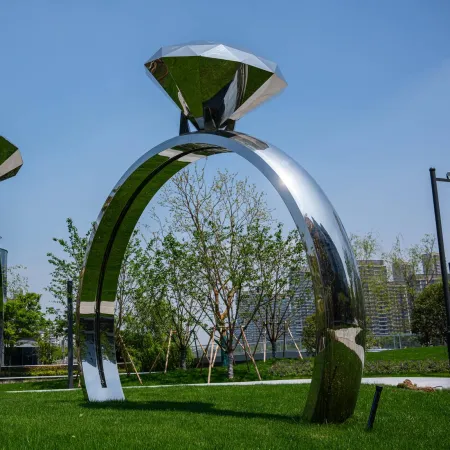
How we control tolerances and finishing is described in the services overview, and a geometric stainless work built around circular forms is The Diamond Rings. Other precision stainless projects appear in the project gallery.
Send us your geometry and the tolerances that matter to you, and we will tell you what is achievable and how we will measure it. Built with that discipline, a geometric stainless steel sculpture arrives as crisp on site as it was on the drawing.