Why Architectural Stainless Steel Sculpture Suits Modern Building Projects
An architectural stainless steel sculpture is a commissioned artwork fabricated from stainless steel, the material most associated with modern architecture, and chosen for its strength, its corrosion resistance and its extraordinary range of surface finishes. Stainless steel is the default answer for many of the sculptural works we deliver because it holds a form, a finish and a reflection for decades with modest maintenance. In this guide we explain what stainless steel offers architecture and where it deserves to be used.
Stainless steel and modern architecture speak the same language. Glass, steel and polished surfaces define the contemporary skyline, and a stainless sculpture set against that context feels native rather than imported. The material can be mirror-polished to reflect its surroundings, brushed to a quiet satin, or finished with color and pattern, and it can be formed into sweeping organic shapes or crisp geometric volumes. Few materials offer that range while also standing outdoors for decades.
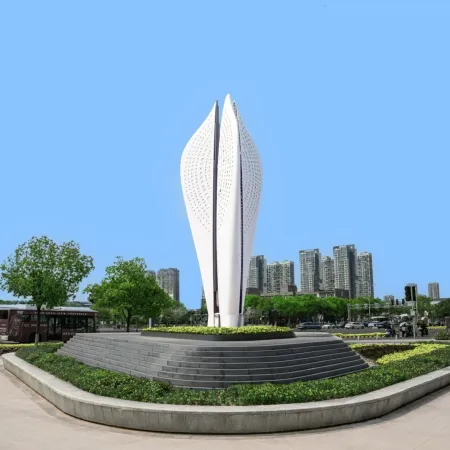
Stainless is a material our studio works in daily, and the same route of consultation, concept development, fabrication and installation that we describe on our services overview applies to every stainless commission, with completed works in our project archive. A clear demonstration of stainless at architectural scale is Peach Blossom, a 20.8 m stainless steel petal gateway that reads as a landmark in its setting.
Choosing the Right Stainless Steel Grade
Stainless steel is a family of alloys, not a single material, and the grade must be chosen for the site. Type 304 is the standard architectural grade, offering excellent corrosion resistance for most inland and urban environments. Type 316 adds molybdenum, which resists chlorides, making it the right choice for coastal sites, de-icing salt zones and aggressive industrial atmospheres. Within the chosen grade, the finish and the detailing determine how the material behaves over decades, which is why we specify both grade and surface with the site in mind.
The engineering must also respect the material's character. Stainless steel expands and contracts with temperature, so large sculptures are detailed with movement accommodation. Welds must be controlled and passivated so the corrosion resistance is continuous across the joint. And contact with other metals must be managed to avoid galvanic corrosion. These are the details that keep a stainless sculpture pristine when lesser work is showing its age.
The Language of Stainless Steel Finishes
The finish is the personality of an architectural stainless steel sculpture. Mirror polish turns the sculpture into a living reflector that changes with the sky and its surroundings, which suits works meant to engage their environment. A brushed or satin finish softens the light and reads quietly against glass and stone. Bead-blasted surfaces diffuse reflection for a matte, contemporary feel. And colored stainless, achieved through PVD coating, opens a palette of warm tones while keeping the material's durability.
Finish selection is also a maintenance decision. Mirror surfaces show fingerprints and require more care in public settings, while brushed and blasted finishes are forgiving. For works that will be touched, we often recommend a brushed finish or a protected mirror treatment, and we always confirm the finish direction with the client through samples before production. The approved sample becomes the standard for the entire work, because finish consistency across large surfaces is what makes a sculpture look intentional.
Reflection, Light and Architectural Context
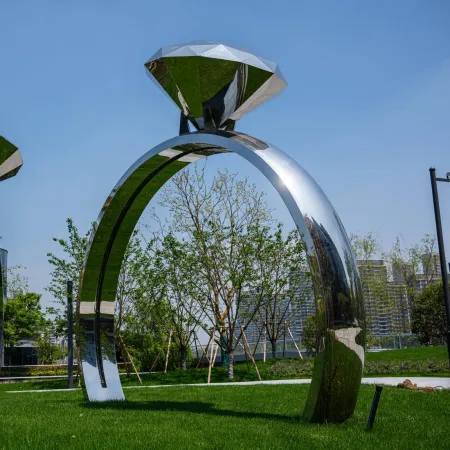
A mirror-polished stainless sculpture does something no painted surface can do: it borrows its environment. The sculpture reflects the building beside it, the trees around it and the people passing it, so it changes continuously and belongs to its place in a literal sense. Architects use this quality to tie a work to its context, letting the sculpture echo the architecture without copying it. We design the form with the reflections in mind, shaping surfaces so the sculpture reads clearly even as it mirrors the world.
Lighting completes the relationship. Stainless responds beautifully to artificial light, and a sculpture that disappears into a dark plaza by night can be transformed by well-planned illumination. Whether the light comes from uplights at the base, spots from neighboring buildings or integrated elements within the work, we coordinate the lighting with the design so the sculpture performs from morning to midnight. A stainless work that is lit well becomes a landmark twice a day.
Structural and Fabrication Discipline for Stainless
Stainless steel is strong, which allows slender and dramatic forms, but the strength only helps if the structure is engineered honestly. Wind loads, self-weight and foundations are calculated and documented, and the sculpture is fabricated to tolerances that keep large surfaces fair and true. Fabricating stainless well requires controlled procedures: welding with the right heat input, grinding without damaging the surface, and finishing through the grits in the right sequence. We do this work in-house because that is the only way to hold the standard.
For large stainless works we also plan the sectioning, transport and erection so the material arrives and assembles without damage. Stainless surfaces are vulnerable during handling, so cradles, protective films and careful site procedures are part of the delivery. The effort is invisible in the finished work but essential to it, and it is the difference between a sculpture that looks like one continuous object and one that shows its seams.
Finish Options We Produce for Stainless Steel
- Brushed for a soft, directional sheen that hides minor handling marks
- Mirror for maximum reflection that pulls the sky and the city into the form
- Colored through PVD or coating systems for brand-matched projects
- Bead-blasted and patterned for a matte, even texture in high-contact public settings
Caring for a Stainless Steel Sculpture
One of stainless steel's great advantages is its modest maintenance. In most environments, periodic cleaning with water and a mild detergent keeps the surface in good condition, and the schedule can be lighter than for painted or coated materials. In coastal or polluted environments, more frequent cleaning may be needed to prevent surface staining, and we specify the regime honestly for the site. We deliver the care schedule with the work, so the owner knows exactly what the sculpture needs.
Our confidence in stainless comes from evidence. Since 2003 our studio has delivered thousands of installed works across more than twenty countries, and a large share of those are stainless steel sculptures that have weathered real climates, real cleaning regimes and real public contact. That history informs every grade selection, every finish sample and every detailing decision we make today.
Comparing Stainless Steel with Other Sculpture Materials
Stainless steel is the right answer for many projects, but not all, and honest advice means comparing it with the alternatives. Bronze brings warmth and a traditional gravity that stainless cannot imitate, but it is heavier and needs more care. Weathering steel offers an industrial earthiness at lower cost, but it lacks the reflective life of polished stainless. Painted steel and aluminum allow color, but their coatings will need renewal while a stainless surface endures. We lay out these trade-offs for every client, because the best material is the one that fits the site, the form and the owner's appetite for maintenance.
Where stainless wins is the combination of longevity and presence. No other material holds a mirror finish outdoors for decades, and few match its resistance to the environments that destroy lesser metals. For a client who wants a modern work that will still look authoritative in twenty years with minimal care, stainless is very often the answer, and we say so plainly. Equally, when another material serves the project better, we recommend that instead, because our reputation rests on advice the client can trust.
Cleaning stainless steel is simple when the right habits are followed, and the habits matter more than the products. In most environments, regular rinsing with clean water and an occasional wipe with a mild detergent keeps the surface bright, while abrasive cleaners and steel tools should never touch the finish because they embed particles that cause rust-like staining. For mirror surfaces in public settings, a periodic professional clean keeps the reflection flawless. We include these practical instructions in every maintenance schedule, because a stainless sculpture that is cleaned correctly stays beautiful with remarkably little effort.
How a Stainless Steel Commission Progresses
- Grade selection against site climate and budget priorities
- Forming and welding with dimensional control per module
- Finish program on approved sample panels
- Protective detailing, inspection and installation
Common Questions About an Architectural Stainless Steel Sculpture
Will stainless steel rust?
True stainless does not rust in the way carbon steel does, but surface staining can occur in harsh environments if the grade is wrong or the surface is neglected. Choosing the right grade and cleaning regime prevents it.
Can you match the finish to our building facade?
Yes. We develop finish samples to sit beside your actual materials, whether that is mirror, brushed, blasted or colored stainless.
Is stainless suitable for coastal locations?
Yes, with 316 grade and appropriate detailing. We specify for the real conditions of your site rather than a generic standard.
How is the finish kept consistent across a large surface?
Large stainless surfaces are finished in staged passes with consistent technique and direction, checked under the same lighting conditions each time. That discipline is what keeps a multi-meter sculpture reading as one continuous surface instead of a patchwork of panels.
Can stainless be combined with lighting or other metals?
Yes. Stainless integrates naturally with programmed lighting and with accent metals such as bronze or corten details, and the junctions are engineered so each material keeps its own corrosion behavior over decades outdoors.
Stainless steel earns its place in architectural sculpture because it combines the two things modern buildings demand: a material that can hold ambitious form and a surface that stays true for decades. When the grade is chosen for the site, the finish is locked by samples and the fabrication is held to a real standard, an architectural stainless steel sculpture becomes an asset that outlasts trends and keeps reflecting its place beautifully.
If your project is considering stainless, send us your design or your site and ambitions. We will advise on grade, finish and detailing, and show you samples of what an architectural stainless steel sculpture can be before you commit.