What an Abstract Sculpture Manufacturer Must Solve Before the Form Stands
An abstract sculpture manufacturer works without the safety net of nature. There is no anatomy to check against, no portrait to resemble and no obvious way to tell whether the work is right, so the geometry itself becomes the specification. Every curve, every edge and every plane has to be set out, verified and held, and that is a manufacturing problem long before it becomes an artistic one.
Yifeng Sculpture Studio has manufactured abstract work since 2003, delivering more than 3000 works to 23 countries in stainless steel, mild steel, aluminium, bronze, composite and glass. Our engineering and production teams share one building with the design studio, which matters enormously for abstract sculpture, because a non-representational form cannot be corrected by eye on site. It has to be resolved in the drawing and proven in the workshop.
Why Abstract Work Tests a Manufacturer Differently
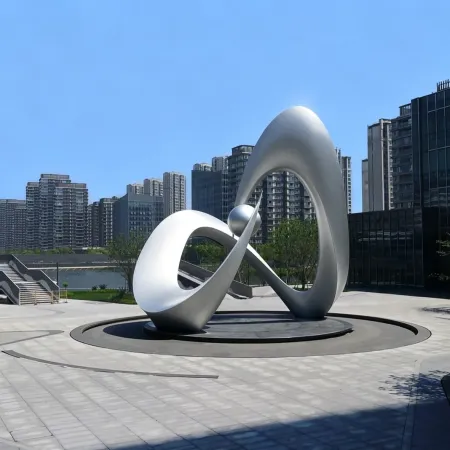
In figurative work the human eye is an instrument. Anyone can see that a shoulder sits wrong or a hand is too small, so errors surface quickly and can be corrected by judgement. Abstract work removes that instrument. A twisted ribbon, a stack of voids or a spiral of tapered plates has no external truth to compare against, and the only references are the approved model, the setting-out drawings and the measured points. A manufacturer that relies on instinct alone will drift, and the drift will only become visible when the sections are assembled.
That is why abstract commissions place a premium on the digital chain. A sculpted maquette is scanned or modelled, the surface is divided into buildable panels, the panel geometry is unfolded into flat patterns and the patterns are cut to a tolerance the assembly can absorb. Where the form is doubly curved, the panels are pressed or rolled against purpose-made formers rather than persuaded by hand. The manufacturer is not improvising; it is executing a geometry that has already been proven on screen.
| Challenge | Manufacturing response | Why it matters |
|---|---|---|
| No anatomical reference | Digitised model plus full-size setting-out drawings | Errors cannot be judged by eye at the end |
| Compound curvature | Formers, jigs and pressed or rolled panels | Hand-forming drifts across a repeated series |
| Thin edges and shadow lines | Controlled weld dressing and planned seam placement | In abstract work the silhouette is the artwork |
| Mirror or satin finish | Physical finish samples approved before production | Reflection reveals every wave and joint |
How an Abstract Sculpture Manufacturer Resolves Structure
Abstract forms often hide their structure in plain sight. A slender column that appears to lean, a cantilever that seems to float or an open lattice that looks weightless all require internal engineering that must not announce itself. The manufacturer's task is to make the structure disappear: stiffeners placed where they cannot be seen, wall thickness tuned so the skin does not oil-can under a mirror polish, and connections designed so that the seams fall on a change of plane rather than across a highlight.
The sequence matters as much as the design. Welding draws metal, and in a large abstract form the accumulated shrinkage can pull a face out of true by more than the tolerance allows. Serious manufacturers plan the weld sequence, use tacking and back-stepping, allow for distortion and measure the geometry against the setting-out at defined stages rather than only at the end. By the time the piece is ready for finishing, the form is already correct and the polisher is not being asked to hide a problem with abrasives.
- Set-out first: a full-size setting-out on a steel bed gives every component the same reference, so parts made weeks apart still meet.
- Purpose-built jigs: jigs and formers turn a one-off shape into a repeatable one and hold the geometry while it is welded.
- Sequenced welding: a planned order of welds and controlled heat input limit the distortion that pulls a large form out of line.
- Stage measurement: dimensional checks at defined gates catch a deviation while it is still cheap to correct rather than after finishing.
- Distortion allowance: the drawing carries a small allowance for movement, so the finished work lands on the intended line.
Surface, Finish and the Reading of Form
On an abstract piece the finish is the form. A mirror polish reveals every wave, every weld and every panel joint, so the surface work is where an abstract sculpture manufacturer earns or loses the commission. Panels must be matched for flatness before polishing, seams must be dressed so the reflection runs unbroken and the final abrasive sequence must be consistent across the whole work, because a change of direction in the polish reads to the eye as a change of shape.
Different finishes tell different stories, and the choice should be made with samples viewed in the light of the actual site. A satin finish softens a hard geometry and forgives handling marks; a brushed finish gives direction and movement; a mirror finish dissolves the object into its surroundings and makes it change with the weather. We produce sample plates in the specified system and let the client and the artist approve them in daylight and at night before production, because a decision made on a screen will look different on a plaza at noon.
What Abstract Work Demands From a Manufacturer
Geometry proven before any metal is cut
Structure that disappears into the form
A surface that reads as one continuous gesture
Records that let the work be repaired decades later
Materials and Methods for Non-Representational Work
Material choice in abstract work is a design decision as much as a technical one, because the same geometry behaves differently in each material. Stainless steel allows thin sections, sharp edges and a mirror face that reflects the sky; mild steel suits mass, rusted patina and a weightier presence; aluminium reduces weight for a roof-mounted form; bronze offers a warm, changing surface that ages with grace. A manufacturer should be able to argue for each option in terms of the form rather than the price list, and to explain what each will look like after ten winters.
Method follows material. Sheet forms are cut, rolled, pressed and welded; cast forms are modelled, moulded, cast and chased; composite forms are tooled and laminated. Many abstract works combine two or three of these, and the manufacturer must manage the interfaces between them, thermal movement, galvanic isolation between steel and aluminium, and the different expansion rates that can crack a rigid joint over a few seasons. Those interfaces are where a poorly planned abstract work fails first.
- Define the geometry: agree the reference model and the setting-out drawings that every later decision is measured against.
- Choose the material for the form: match alloy and thickness to the silhouette, the span and the exposure rather than to habit.
- Build the tooling: formers and jigs are the cheapest insurance a manufacturer can buy against a wandering shape.
- Prove the finish: approve physical samples in site light before committing the whole work to a surface treatment.
Working With Artists on Abstract Commissions
Most abstract commissions arrive from an artist, an architect or a designer with a maquette and an intention. The manufacturer's first job is to understand the intention, not merely the shape, because the two can diverge when a small model is enlarged. A form that reads as soft at 300mm can read as brutal at six metres; an edge that looks crisp in a photograph can become a hazard at full scale. Those conversations belong at the start, before the drawings are frozen.
From there the relationship should be documented rather than remembered. We agree the reference model, the approved finish samples and the setting-out drawings, and we treat them as the contract for the artwork. Where the engineering requires a change, it is raised with options and implications rather than absorbed silently, so the artist always knows what the built work will be. That transparency is what allows a manufacturer and an artist to work together more than once.
Frequently Asked Questions About an Abstract Sculpture Manufacturer
Can an abstract form be built from a hand-made maquette?
Yes. The maquette is scanned or modelled into a digital surface, then divided into buildable panels so the enlarged form can be measured rather than guessed.
How do you stop a mirror finish showing waves?
By matching panel flatness, tuning wall thickness against oil-canning, sequencing welds and measuring at gates, so the surface is right before the polisher begins.
Which materials suit a large abstract work outdoors?
Stainless steel, weathering steel, aluminium and bronze all work outdoors, and the right choice depends on the form, the span, the climate and the finish you want in ten years.
How is an abstract work checked for accuracy?
Against the setting-out drawings and measured points at defined production gates, because there is no anatomical reference to judge the form by eye.
Can you work directly with the artist's own engineer?
Yes, and we prefer it. A shared model and a shared set of drawings remove ambiguity, and the artist keeps control of the intent while the engineering is proven.
An abstract sculpture manufacturer is really a geometry manufacturer. The artistry arrives as a model, a drawing or a written intention, and everything after that is a discipline of measurement, tooling, sequencing and finish control that decides whether the built work still carries the idea it started with. When those systems are in place, abstraction stops being risky and becomes simply demanding.
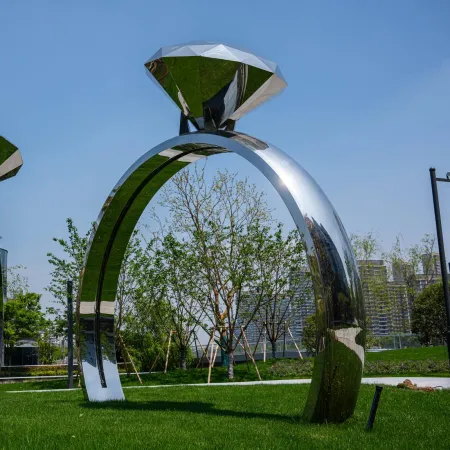
You can judge our command of non-representational form by looking at what we have built. Browse our project gallery for a sense of the range, read the services overview to see how design and production connect, and study The Diamond Rings, a work whose geometry had to be exact before a single panel was polished.
Bring us the model, the sketch or the intention, and we will tell you honestly what it will take to build it. An abstract sculpture manufacturer that shows you the tooling, the setting-out and the records is a manufacturer whose geometry you can trust.