How Custom Metal Sculpture Fabrication Turns a Concept Into Steel
Custom metal sculpture fabrication is the discipline that decides whether an approved design becomes a triumph or a disappointment, because everything that can go wrong in a commission happens between the final render and the finished steel. The curves that looked effortless on screen must be rolled and welded true, the mirror finish must survive handling, and the structure must stand for decades in weather it has not yet met. After more than two decades fabricating custom metal sculpture in our own workshops and shipping works across twenty-three countries, I have learned that the fabrication stage rewards clients who understand it.
This guide walks through custom metal sculpture fabrication stage by stage so you know what to expect, what to approve and what to inspect.
See Artistic Light Columns as a study in precision fabrication, watch how Rainbow Windmills resolved complex colour in metal, and review Butterfly Dance for large-scale cut-metal fabrication.
What Custom Metal Sculpture Fabrication Actually Involves
Custom metal sculpture fabrication is the full journey from approved design to finished, transportable work, and it involves far more than welding steel together. The journey begins with translating the design into fabrication files and full-scale templates, continues through cutting, forming, welding and finishing, and ends with crating and delivery planning that protect everything achieved in the workshop. Each stage has its own skills, its own risks and its own quality checks, and a workshop that controls all of them will deliver a different result from one that subcontracts the difficult steps.
Clients often assume that once the design is approved, the rest is automatic, but the reality is that fabrication is where the design meets physics. A form that looks elegant in a 3D model must be divided into sections that can be rolled, welded, transported and erected; a curved surface must be achieved with tolerances measured in millimetres across metres of steel; and every decision, from weld sequence to seam placement, affects the final appearance. Understanding this is the first step to commissioning fabrication that honours the design.
From Approved Design to Cutting Line
Custom metal sculpture fabrication begins with the digital-to-physical translation, where the approved 3D model is converted into the files and templates that guide the cutting tables. Sections are planned to suit the capacity of the forming equipment and the limits of transport, seams are positioned where they will be least visible or most expressive, and allowances are made for the thickness of the metal and the behaviour of the material during forming. This planning stage is invisible in the finished work and absolutely decisive to its quality.
Full-scale templates and mock-ups matter enormously for custom work, because a sculpture is experienced in real space, not on a screen. Before expensive plate is cut, a serious workshop will confirm critical proportions at full scale, whether through sectional templates, a physical mock-up of a defining curve or a full-scale sample of a complex junction. These checks cost a fraction of a fabrication error, and they are the reason a disciplined workshop rarely has to scrap and remake major sections.
| Fabrication stage | What happens | Quality check |
|---|---|---|
| Digital translation | 3D model becomes cutting files and templates | Seam placement and section plan approved |
| Cutting and forming | Plate is cut and rolled into three-dimensional form | Tolerances verified against the model |
| Welding and assembly | Sections are welded and the form is unified | Welds inspected and seams prepared |
| Finishing and protection | Surfaces are ground, polished or painted | Finish inspected and protective film applied |
Forming and Welding: Where the Sculpture Takes Shape
The heart of custom metal sculpture fabrication is the forming and welding bay, where flat plate becomes three-dimensional form. Plate rollers bend steel into curves, presses shape tighter radii, CNC cutting produces precise profiles, and skilled welders join the sections into a unified whole. The quality of this stage decides both the structure and the appearance of the work, because a weld that is ground and finished with care disappears into the surface while a careless weld remains visible for the life of the sculpture.
Welding large sculpture is a discipline of sequence and control. Sections must be joined in an order that prevents distortion, heat input must be managed so that curves hold their true shape, and the structure must be verified as it is built rather than discovered to be wrong at the end. This is why the workshop matters, the welders, the equipment and the supervision are the difference between a sculpture that looks machined and one that looks assembled.
Finishing: The Surface Is the Voice
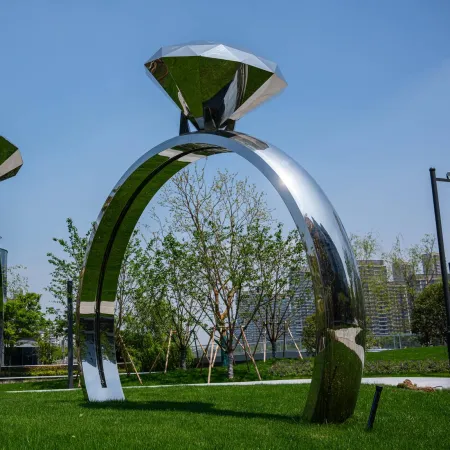
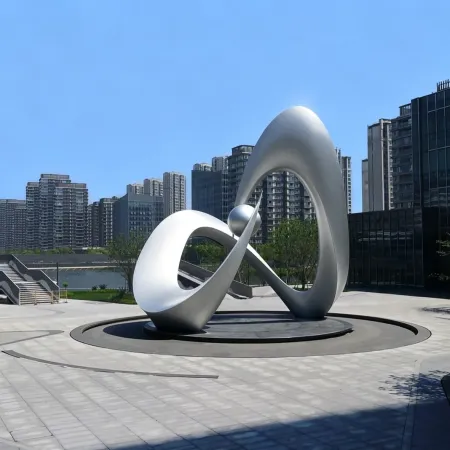
After assembly, custom metal sculpture fabrication turns to the surface, and the surface is what the public actually experiences. A mirror-polished stainless work must be progressively refined through ever-finer abrasives until the reflections are true; a painted work must be prepared, primed and coated in controlled conditions so that the colour is even and durable; a weathering steel work must be finished so that its patina develops evenly. Each finish demands its own environment, skills and quality standards.
The finishing stage is also where the work is protected for its journey. Mirror surfaces receive protective film, painted surfaces are allowed to cure fully before handling, and all sections are prepared for crating with the care the finish demands. A workshop that finishes and protects in-house controls the quality to the moment of packing, rather than handing a delicate surface to an unknown handler at the workshop door.
- Translate first: cutting files and templates protect the design
- Verify at full scale: mock-ups catch errors before plate is cut
- Control the weld: sequence and heat protect the true form
- Protect the finish: surfaces must survive to the site
Milestones and Approval Gates
A disciplined fabrication process is built on approval gates that keep the client informed and the work on track. The first gate is the fabrication plan itself, the sectioning, the materials and the schedule, approved before cutting begins. The second gate is typically a full-scale check of critical proportions or a sample of a defining surface, so that the client sees the reality of the work before it is fully committed. Later gates cover the finished form before finishing and the finished work before crating.
These gates protect both sides. For the client they mean no expensive surprises, because every major decision is made with full information at the moment it matters. For the workshop they mean clear authority to proceed, so that work is never redone because a change was requested after the fact. When fabrication is managed this way, the relationship between client and workshop becomes a collaboration rather than a series of disputes.
The Workshop That Makes Custom Fabrication Reliable
Yifeng Sculpture Studio has performed custom metal sculpture fabrication in its own Ningbo workshops since 2003, with the design and engineering teams working alongside the fabrication crews on every project. This integration means the people who resolved the geometry also control the cutting, forming, welding and finishing, so the work that leaves the workshop is the work that was approved. More than three thousand installed works across twenty-three countries have been built on exactly this discipline.
For clients, the practical benefit is simple, one accountable team from the first sketch to the finished crate. Our academy-trained sculptors protect the artistic intent, our engineers verify the structure, our fabricators build it true, and our export team delivers it intact. When a commission is complex enough to demand custom metal sculpture fabrication, that single-source accountability is the most valuable insurance available.
- One-roof fabrication: design, engineering and building together
- Gate-by-gate approvals: decisions made with full information
- Full-scale verification: mock-ups before expensive mistakes
- Protected delivery: finishes survive to the site intact
Fabrication Without Surprises
Approved designs translated with discipline
Full-scale checks before plate is cut
Finishes protected through to delivery
One workshop accountable for the whole build
Why Clients Should Visit or Verify the Workshop
However detailed the documentation, there is no substitute for seeing custom metal sculpture fabrication in progress, and serious workshops welcome the scrutiny. A visit or structured live video walkthrough lets you watch work at each stage, ask the welders and finishers direct questions and judge the atmosphere of the shop, the organisation, the housekeeping, the care with which works in progress are handled. These signals are honest in a way that portfolios can never be.
For overseas clients who cannot visit, the equivalent is a staged verification programme, live walkthroughs at each fabrication gate, photographs of works in progress and third-party inspection before shipping. A workshop confident in its fabrication will agree to these checks gladly, because it knows the checks will confirm what its reputation claims. If a fabricator resists verification, that resistance is the clearest possible warning about the quality of its work.
Frequently Asked Questions About Custom Metal Sculpture Fabrication
How long does custom fabrication take?
Timelines depend on scale, material and the number of approvals, so a serious workshop builds a schedule from the design phase and reviews it at each gate. Complex large-scale work is measured in months, not weeks, and honest workshops say so from the start.
Can we approve the work before it is finished?
Yes. Serious workshops build approval gates into the process, including full-scale checks of critical proportions and samples of defining surfaces, so you see the reality of the work before it is fully committed.
What materials can be custom fabricated?
Stainless steel, weathering steel, painted steel, aluminium, bronze and combinations of these are all routine in custom work. The right choice follows the climate, the site and the finish the design demands.
Who is responsible if the finished work differs from the design?
In a single-source workshop the fabricator holds that responsibility directly, which is why fabrication quality is verified at every gate. Brokers who subcontract the build offer no such accountability, because the builder was never theirs to control.
How is the finished sculpture protected for shipping?
Mirror surfaces receive protective film, painted surfaces are fully cured, and sections are crated with internal bracing designed for the journey. Export-experienced workshops plan the packing around the finish and the route.
Custom metal sculpture fabrication rewards clients who engage with it, because understanding the stages lets you approve the right things at the right moments. Choose a workshop that plans, verifies, finishes and protects under one roof, and the sculpture that arrives on your site will be the sculpture you approved.
Send us your design and let our custom metal sculpture fabrication team turn it into steel.