Planning an Architectural Landscape Sculpture for Mixed-Use and Civic Projects
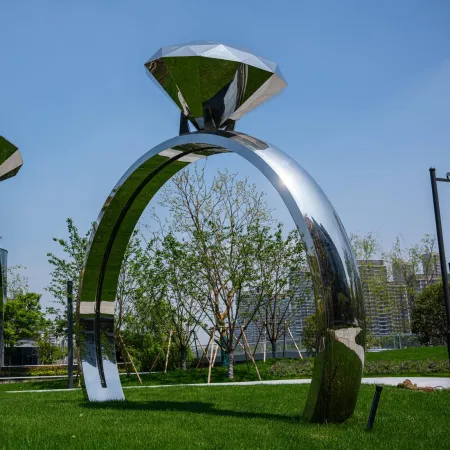
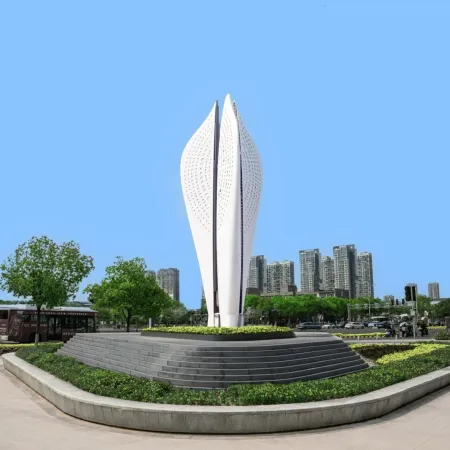
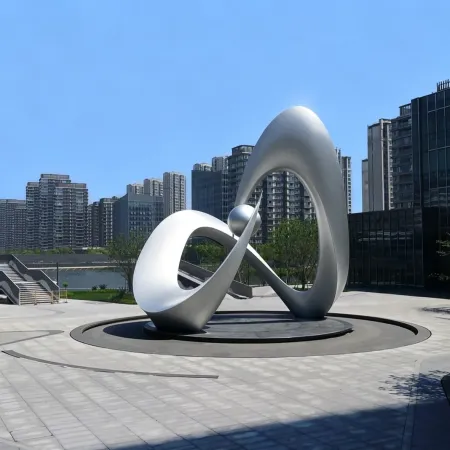
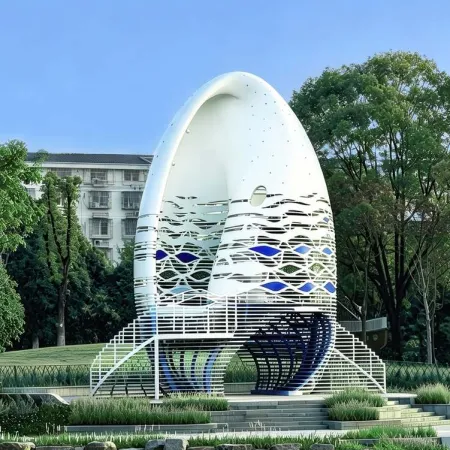
An architectural landscape sculpture is a commissioned artwork that is designed with the landscape itself, positioned where planting, paving, water and pedestrian flow meet the architecture of a site. It is not a statue placed on a lawn; it is a sculptural element that organizes outdoor space, giving a courtyard a focus, a plaza a gathering point and a streetscape a memorable pause. In our studio we treat landscape sculpture as landscape architecture in three dimensions.
The best landscape sculpture we have delivered has always come from projects where the landscape architect and the studio worked from the same drawing set. When the artwork is drawn into the planting plan and the paving grid from the beginning, it arrives with its own drainage, its own foundations and its own sightlines already resolved. When it is added later, it tends to fight the trees for light, the paving for space and the maintenance crew for access. Early coordination is not a luxury; it is the difference between an integrated work and an obstacle.
At Yifeng Sculpture Studio we have delivered outdoor commissions of every scale, and the process always begins with the same structured route of consultation, concept development, fabrication and installation, described on our services overview, with past works gathered in our project archive. One example that shows how sculpture and landscape can fuse is Wisdom Tree, a 10 m interactive lighting installation that behaves like a living feature of its environment.
What an Architectural Landscape Sculpture Contributes
A well-placed landscape sculpture changes how people use outdoor space. It gives a large plaza a reason to be crossed and a place to stop. It gives a residential courtyard an identity that residents reference when giving directions. It gives a commercial campus a piece of the brand that visitors photograph. And for civic projects it creates the sense of a cared-for public realm that encourages people to linger, which in turn supports the cafés, shops and activities around it.
There is also a subtle functional role that clients rarely anticipate. Sculpture can manage movement: a well-placed form directs pedestrians around a service yard, slows traffic at a corner, or screens an unsightly utility structure. When we design with the landscape architect, the artwork earns its place twice, once as art and once as an element of spatial planning.
Designing with the Landscape, Not on It
The discipline of landscape sculpture is restraint. A form that shouts at a quiet garden, or a monument that dwarfs its planting, fails regardless of its own quality. We start by reading the site: the scale of the surrounding architecture, the species and mature size of the trees, the seasonal changes in light, the paths people actually use, and the views from inside the buildings. Only then do we propose a form, and the form is always tested against those site realities.
- Scale against architecture: the sculpture must hold its own beside the building mass without overwhelming the open space.
- Dialogue with planting: we consider mature tree canopies, root zones and irrigation so the artwork and the landscape grow old together.
- Seasonal performance: a form that works in summer leaf and winter bareness is designed for both, not for the render.
- Pedestrian reality: the piece must survive contact with people, bikes and maintenance equipment without becoming fragile.
Materials That Belong Outdoors
Outdoor landscape sculpture lives in the hardest environment of any artwork: full sun, rain, frost, pollution and public contact. Stainless steel in 304 or 316 grade is our most common choice for polished and brushed work, with 316 preferred where salt or aggressive conditions exist. Weathering steel suits landscape settings naturally, developing a stable oxide that echoes earth tones. Aluminum is specified where weight matters, and composite is used for large colored forms. Foundations, fixings and drainage are designed for the specific soil and water table of the site.
Public interaction is a design input, not an afterthought. We round edges where people sit or children play, avoid pinch points and climbable hazards where the client requires it, and detail surfaces so they can be cleaned without special equipment. Our maintenance schedule goes to the landscape management team, not just the building owner, because in most projects that is the team that will look after the artwork for its life.
Coordinating Landscape Sculpture with Site Works
A landscape sculpture is installed during the site works, and its foundation must be coordinated with drainage, services, paving and planting programs. We provide the site team with clear foundation drawings, lifting plans and installation sequences, and we supervise the setting so the artwork lands exactly where the design intended. Because our studio has handled delivery and installation across many countries, our documentation is written for the people who will actually build it.
For developments with multiple phases, we can also design a family of sculptural elements that repeats across the master plan, giving the whole district a consistent artistic language while each piece responds to its own location. This approach, common in large mixed-use and new-town projects, turns scattered public art into a cohesive identity, and it is often more economical than commissioning unrelated works one by one.
Designing Landscape Sculpture for Real Public Use
A landscape sculpture in a public or semi-public space will be touched, climbed on, leaned against and photographed, and the design should welcome that contact rather than fight it. Where children are expected, we round edges, avoid pinch points and check every surface for safety under the relevant standards. Where adults gather, we consider whether the sculpture can double as seating, a shade structure or a stage backdrop, because a form that earns its keep in daily use builds the kind of community attachment that protects it from neglect.
Water, sound and motion can lift a landscape work from object to experience. A water element adds movement and cooling on hot days, a kinetic form responds to wind and gives the space a changing character, and integrated lighting extends the life of the place into the evening. Each of these additions brings engineering responsibilities, from pumps and filtration to bearings and weatherproof electrical systems, and we design them with the same discipline as the sculpture itself so the magic does not become a maintenance burden.
We also plan for the life of the piece beyond opening day. Public landscape sculpture is exposed to the most demanding conditions of any commissioned work, and our delivery includes a clear maintenance schedule, spare-finish documentation and a contact point for future service. That long-term commitment is part of why our installed works have kept their quality across more than twenty countries and thousands of projects since 2003.
There is one more return on landscape sculpture that developers underrate until they see it: naming. A distinctive work gives a development a handle that people actually use, in leasing brochures, ride-share drop-offs and directions between buildings. When we brief a client on a new commission we always ask how the piece might be named, because a name that rolls off the tongue multiplies the value of the artwork in marketing terms. Good landscape sculpture therefore works on three levels at once: as art, as spatial design and as the identity of the place.
The construction phase is where landscape sculpture projects are won or lost in practice, and we protect the work by being present at the right moments. The foundation is poured once, and if the embedments are wrong the sculpture cannot be corrected without breaking concrete, so we verify the setting before the pour. The installation is a moment of high risk for the surrounding landscape, so we protect the planting and paving during the lift. These site disciplines are invisible in the finished work but absolutely visible in its quality and in the condition of the landscape around it.
Siting a Sculpture Within a Landscape Plan
- Joint site walk to study sightlines and approaches
- Placement trials against planting and lighting layouts
- Foundation and drainage design with the landscape team
- Installation scheduled around planting and handover milestones
Common Questions About an Architectural Landscape Sculpture
When should the sculpture enter the design process?
Ideally when the landscape concept is being developed. That is when the artwork can influence the layout rather than adapt to it.
Can the sculpture include water, lighting or sound?
Yes. Interactive and kinetic landscape works are a growing part of our portfolio, and we coordinate the power, drainage and maintenance requirements with the site engineers.
Who maintains a public landscape sculpture?
Typically the landscape management team, using the schedule we provide. We also offer periodic inspection and refinishing services where needed.
How is the base prepared in planted areas?
We coordinate with the landscape contractor on foundation depth, drainage and root protection before any excavation. Anchors are positioned so mature planting is preserved, and the restored ground is finished to match the surrounding surface treatment.
Can a landscape sculpture be relocated in the future?
Yes, when the brief calls for it. We design demountable anchoring and discrete lifting points for works that may travel with a development phase, so the piece can be moved without structural surgery or visible damage.
Outdoor space is the first thing a visitor experiences and the last thing they remember, yet it is often the most under-designed part of a project. An architectural landscape sculpture gives that space a center of gravity, and when it is planned with the landscape rather than placed on it, it will keep working for the life of the development. That is the standard we hold ourselves to in every outdoor commission we take.
If your landscape plan is taking shape, send us the site plan, the planting concept and the project calendar. We will show you where an architectural landscape sculpture can add the most value and what it takes to build it well. Begin the conversation with our studio today.