How a Metal Sculpture Manufacturer Chooses Between Alloys
A metal sculpture manufacturer is making a material decision before it makes anything else, and that decision will still be visible in thirty years. Stainless steel, mild steel, weathering steel, aluminium, bronze and copper each behave differently in the weather, take a different finish, weld differently and cost differently. Choosing between them is a design decision, and the manufacturer should be able to argue the case for each.
Yifeng Sculpture Studio has worked across all of these metals since 2003, delivering more than 3000 works to 23 countries. Because we handle stainless steel, mild steel, aluminium and bronze under one roof, we can recommend a material on the basis of the site and the form rather than on the basis of what our workshop happens to do best. That independence is worth a great deal to a client.
Reading the Site Before Choosing the Metal
The site sets the constraints. Coastal air carries chlorides that pit mild steel quickly and require a higher grade of stainless; industrial atmospheres are acidic and attack coatings and bare metal alike; heavy snowfall brings de-icing salts that stain and corrode; and a desert site brings intense UV and large temperature swings. A metal sculpture manufacturer should ask about all of this before proposing a material, because the same design in the wrong alloy becomes a maintenance liability.
The form matters as much as the exposure. A thin, sharp-edged geometry suits stainless steel, which can be polished and holds a crisp line; a heavier, more grounded mass suits weathering steel or bronze; a large roof-mounted element may need aluminium for its weight. Where the design calls for movement, the alloy also affects bearing loads and inertia. The best material choice is usually obvious once the site and the form are both understood.
| Metal | Character | Where it excels |
|---|---|---|
| Stainless steel | Bright, reflective, corrosion resistant, holds a crisp edge | Coastal sites, high-visibility works, contemporary forms |
| Mild steel | Strong, economical, takes any colour when coated | Colour-critical works, inland sites, structural frames |
| Weathering steel | Living rust patina that stabilises and protects | Landscape and industrial settings where rust is intended |
| Aluminium | Light, naturally oxidising, easy to anodise | Roof-mounted and suspended works, large light forms |
| Bronze and copper | Warm, castable, develops character with age | Monuments, memorials, detailed figurative work |
Welding, Distortion and Mixed Metals
Each metal brings its own welding behaviour. Stainless steel needs controlled heat input and adequate shielding to preserve corrosion resistance, and the weld zone must be cleaned afterwards to remove heat tint that would otherwise become the starting point for corrosion. Aluminium conducts heat away rapidly and needs a different process and technique altogether. Bronze is joined by welding or brazing and then dressed by hand.
Mixed-metal works add the problem of dissimilar materials. Steel and aluminium in contact create a galvanic couple that accelerates corrosion, so the interface needs isolation, and the two metals expand at different rates, so the connection must allow movement. A metal sculpture manufacturer who understands these interfaces can combine materials expressively; one who does not will produce a work that fails at exactly the point where the two metals meet.
- Qualified welders: processes and qualifications matched to the alloy, with procedures recorded rather than assumed.
- Post-weld cleaning: heat tint and spatter removed so stainless steel keeps the corrosion resistance the grade promises.
- Galvanic isolation: barriers and insulators wherever two different metals meet, so one does not sacrifice the other.
- Movement allowance: slotted or flexible connections where thermal expansion differs across an assembly.
- Distortion control: balanced welding and jigging so a long seam does not pull the form out of line.
Finish: Where Metal Becomes Art
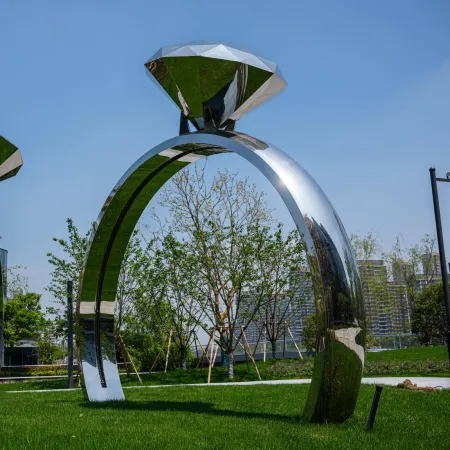
Metal finishes range from a mirror polish that dissolves the object into its surroundings to a hand-brushed surface that gives direction and movement, and from a matt powder coat to a deliberate rust patina. Each finish changes how the work reads and how it ages, and each demands a different discipline in the workshop. A brushed finish must run consistently in one direction; a polished finish must be free of waves; a patina must be developed evenly across the whole surface.
The finish should always be approved as a physical sample in the light of the site. A satin surface that looks refined indoors can look flat in strong sun, and a mirror finish that looks spectacular in a showroom will reveal every panel joint in a plaza. A metal sculpture manufacturer who insists on sample approval is protecting both the client and the artwork from a decision that is expensive to reverse.
Choosing Metal With Confidence
Alloy matched to the site's weather and chemistry
Welding procedures written for each material
Interfaces isolated where metals meet
Finish approved as a physical sample, not a screen
Maintenance and the Honest Conversation
Every metal finish carries a maintenance expectation, and the client deserves to hear it before the commission rather than after. A polished stainless surface needs periodic cleaning to remove salt and pollution; a powder-coated surface can be washed and, if damaged, touched up with a matching repair system; a weathering steel work needs to be allowed to develop its patina undisturbed; a bronze surface may benefit from rewaxing.
The honest manufacturer states those expectations, provides a matching repair system for site damage and explains what will happen if the work is left alone. Some finishes age gracefully without intervention; others will degrade if neglected. A metal sculpture manufacturer who can describe that difference clearly is giving the client the information they need to choose a finish they can live with for decades.
- Match alloy to exposure: ask about salt, pollution, frost and UV before the material is chosen rather than after.
- Sample every finish: approve the actual surface on a physical plate, viewed in the light and at the distance the work will be seen.
- Isolate mixed metals: use barriers and movement-tolerant fixings wherever two materials are joined.
- Supply touch-up: a matching repair system for site damage, applied before handover so the finish starts complete.
- Explain the ageing: what the surface will do over time, how to clean it and which treatments will harm it.
Repairing and Blending Metal Surfaces
Metal surfaces can be repaired, and how well depends on the finish. A painted surface can be touched up with the matching system and blended into the surrounding area. A brushed finish can be reworked in the same direction and will disappear if the abrasive grade and the direction match. A mirror polish is the least forgiving: a local repair will show unless the whole panel is repolished, which is why we keep a matching repair procedure and, where possible, a spare panel from the original production.
Patina is a special case. A weathered bronze or a rusted steel surface develops a colour that cannot be reproduced with a brush, so repairs are usually allowed to weather into the surrounding surface rather than being colour-matched immediately. A metal sculpture manufacturer should explain that process to the owner in advance, because an owner who expects an invisible repair on the day of the fix will be disappointed by a result that will look right in a year.
Frequently Asked Questions About a Metal Sculpture Manufacturer
Which metal is best for a coastal site?
A suitable grade of stainless steel or bronze is normally the safest choice, because chlorides attack mild steel quickly and will pit it unless the coating system is maintained carefully.
Can you combine steel and aluminium in one work?
Yes, with galvanic isolation at every interface and connections that allow for the different expansion rates, so neither metal attacks the other or cracks the joint.
How do you keep a polished surface free of waves?
By controlling panel flatness, wall thickness and weld sequence before polishing, so the surface is geometrically correct before the abrasive work begins.
Does a weathering steel finish need maintenance?
It is largely self-maintaining once the patina stabilises, but the detailing must allow drainage and airflow, and runoff onto paving or building surfaces should be managed from the start.
How many finishes can a single work combine?
As many as the design requires, provided each is sampled and each is protected against the others where materials meet, including isolation between coated and bare surfaces.
A metal sculpture manufacturer is really a material adviser first and a fabricator second. Choose the alloy for the site, weld it with the right procedure, isolate it where it meets another metal and finish it with a surface the client has actually seen. Those four decisions determine whether the work improves with age or becomes an expensive lesson.
Metal work in several alloys is documented in our project gallery, and the full delivery chain is described in the services overview. For an example of a work where reflection and finish carry the whole idea, look at The Radiant Galaxy.
Tell us the site and the look you want, and we will recommend the metal and the finish with reasons. A metal sculpture manufacturer who can defend every material choice is one whose work will still look deliberate in twenty years.