How Stainless Steel Sculpture Fabrication Handles Grades and Finishes
Stainless steel sculpture fabrication is the most common choice for modern public art, and it is also the most commonly done badly. The material is unforgiving: it moves when welded, it shows every scratch it has ever received and it will corrode if the wrong grade is used near the sea. Handled properly it produces work of extraordinary clarity and longevity; handled casually it produces a sculpture that looks tired within two years.
Yifeng Sculpture Studio has fabricated stainless steel works since 2003, delivering more than 3000 pieces to 23 countries, from kinetic devices to twenty-metre gateways. Our engineers and craftsmen share one building, so the grade, the section, the joint and the finish are decided as one specification rather than four separate guesses.
Choosing the Grade Before Anything Else
The grade is the first decision and the one most often made on price. A 304 grade resists corrosion in ordinary inland atmospheres and is adequate for many sites. A 316 grade contains molybdenum, which makes it markedly more resistant to chlorides, and it is the responsible choice for coastal locations, for sites near salt-treated roads and for any work where cleaning will be infrequent. Choosing 304 to save money on a seafront is a decision the client will regret in five years.
There are also higher grades and duplex alloys for extreme environments, and there are low-carbon variants that weld more safely in thick sections. The choice should follow the site's exposure and the fabrication method rather than a default, and the client should be told plainly which grade is proposed and why. In stainless steel sculpture fabrication, the grade conversation is the most valuable five minutes of the whole project.
| Grade | Suitable site | Practical note |
|---|---|---|
| 304 | Inland sites with moderate pollution | Cost-effective, but it will pit near salt |
| 316 | Coastal and heavily exposed public sites | Molybdenum resists chlorides; still needs cleaning |
| Low-carbon variants | Thick sections and heavy welding | Reduces the risk of weld decay |
| Duplex alloys | Extreme chloride or chemical exposure | Higher strength and cost, for demanding sites |
Welding Without Distortion
Stainless steel expands more than mild steel when heated and conducts heat less efficiently, so welding introduces distortion that is difficult to remove. The fabricator must control it with a balanced welding sequence, with tacking that holds the geometry, with temporary bracing and with heat input kept as low as the joint allows. Where the surface will be polished, every weld must also be dressed back to the parent metal so that the grain or the reflection continues without interruption.
After welding, the surface must be passivated so that it recovers its corrosion resistance. Welding burns away the passive layer and leaves the joint vulnerable to rust, and a workshop that skips passivation will deliver a sculpture that develops brown streaks along every seam within a season. This step is invisible, cheap and absolutely decisive, and its absence is one of the clearest signs of a workshop that does not really understand stainless steel sculpture fabrication.
Finishes From Satin to Mirror
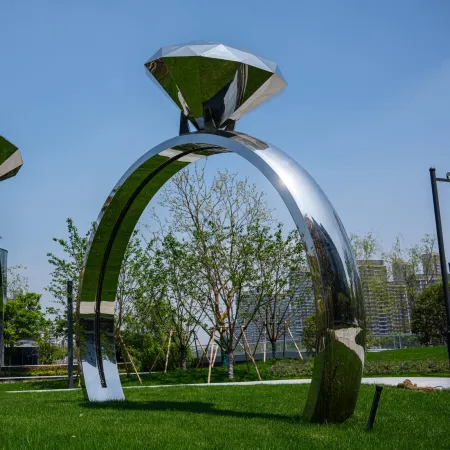
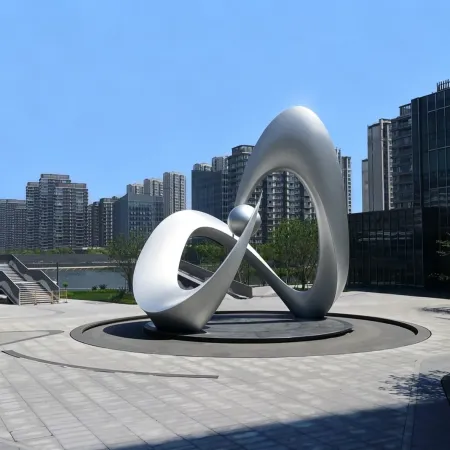
A satin or brushed finish is produced by working the surface with a controlled abrasive sequence to create a consistent grain, and it is the most practical choice for public work because it hides small marks and is easy to maintain. A mirror finish is produced by polishing progressively finer until the surface reflects clearly, and it is spectacular but demanding: it shows every fingerprint, every water mark and every scratch, and it requires regular cleaning to look its best.
Some projects combine finishes, using a mirror for the surface that catches the sky and a satin for the surfaces the public touches. Others use a coloured or textured stainless finish to reduce glare or to create a specific mood. Whatever the choice, we produce samples on real material and let the client judge them in the light of the site, because a finish approved on a small swatch can behave very differently across a twenty-metre form.
What Stainless Steel Demands
The grade chosen for the site, not for the price
Welding sequenced to keep the form free of distortion
Passivation after welding so joints do not rust
Finish samples approved in the light of the real site
Protecting the Finish Through Transport and Installation
A stainless finish is at its most vulnerable between the polishing bay and the site. We protect the surfaces with a removable film, crate the sections so that finished faces never touch anything hard and brace the load so it cannot shift. At installation the protective film stays in place until the last moment, and the work is handled with soft slings rather than chains. A scratch acquired in transit is expensive to remove on site and impossible to remove if it is deep.
We also brief the installation crew on handling, and we supply touch-up instructions for the finish so that a minor mark can be addressed locally without sending for the workshop. A client who receives a stainless sculpture with its finish intact and its documentation complete has received the whole product, and the difference between that and a damaged delivery is entirely in the planning of stainless steel sculpture fabrication.
Repairing and Refinishing Stainless Steel
Stainless steel can be repaired, which is one of its great advantages, but the repair must match the original finish or it will be permanently visible. A deep scratch on a satin surface is removed by re-establishing the grain over a wider area and blending the edges, and a scratch on a mirror surface may require repolishing a whole panel rather than a spot. The repair method should therefore be documented with the work, so that a future owner knows what is possible and what will make the damage worse.
Tea staining is the most common complaint about stainless steel in service, and it is usually a maintenance issue rather than a material failure. The brown discolouration is surface contamination, often carbon or chloride deposits, and it is removed with a mild cleaner and a non-abrasive pad. Understanding that distinction saves owners from expensive interventions and from the belief that their sculpture is corroding. We explain it in the care schedule so that a small cosmetic issue is not mistaken for a structural one.
Where a genuine defect exists, it is usually a weld that was not properly passivated or a fixing that allowed water to sit against the metal. Both are repairable: the joint can be cleaned and passivated, and the detail can be redesigned to drain. A repair that addresses the cause rather than the symptom will last, while a cosmetic fix that leaves the water trap in place will fail again within a season. We always look for the cause before we touch the surface.
Refinishing also offers an opportunity to refresh an older work. A stainless sculpture that has been in service for fifteen years can be cleaned, re-grained and repassivated to look almost new, and the cost is a fraction of replacement. For a city with an ageing collection that is a far better use of budget than commissioning replacements. Stainless steel is one of the few sculpture materials that can genuinely be brought back, and a documented finish record makes the process straightforward.
Frequently Asked Questions About Stainless Steel Sculpture Fabrication
Should I choose 304 or 316 stainless steel?
Use 304 for mild inland sites and 316 for coastal or heavily exposed locations, where chlorides would otherwise pit the surface over time.
Why do stainless welds rust?
Welding destroys the passive layer that protects the metal, so the joint must be passivated afterwards or it will develop brown staining within a season.
Is a mirror finish practical outdoors?
It is spectacular but demanding, showing every mark, so it needs regular cleaning, while a satin finish hides small marks and is easier for a public owner to maintain.
How is distortion avoided when welding?
With a balanced welding sequence, temporary bracing, controlled heat input and dimensional checks at every stage of the assembly.
How is the finish protected before installation?
With removable protective film, crating that keeps finished faces apart and soft slings during installation, plus local touch-up instructions for minor marks.
Stainless steel rewards precision and punishes shortcuts more visibly than any other sculpture material. Choose the grade for the site, control the welding, passivate the joints and protect the finish to the last moment, and the work will look new for decades.
If your project depends on a stainless surface that stays flawless, let us specify it properly. See the stainless work we have delivered in our project gallery, review the full production chain on the services overview, and study Peach Blossom, a 20.8-metre stainless gateway whose every petal had to hold a consistent finish across a vast surface.
Stainless steel rewards precision and punishes shortcuts more visibly than any other sculpture material. Choose the grade for the site, control the welding and protect the finish, and stainless steel sculpture fabrication will give you a surface that looks new for decades.