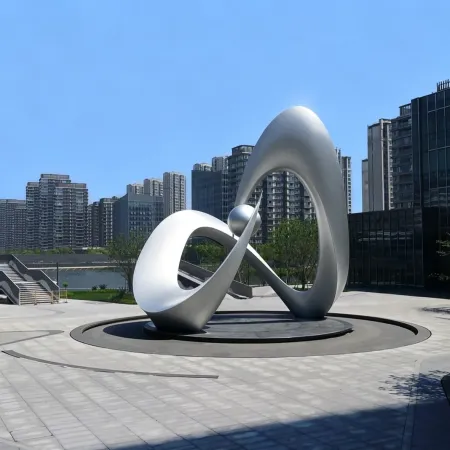
How a Composite Material Sculpture Manufacturer Builds Large Forms Lightly
A composite material sculpture manufacturer solves a problem that metal cannot: how to make a very large form that is light enough to move, cheap enough to install and detailed enough to carry fine surface modelling. Fibre-reinforced polymer gives the sculptor a freedom that casting and fabrication both restrict, because the mould takes the shape from the model rather than the material imposing its own logic.
Yifeng Sculpture Studio has worked in composite since 2003, delivering more than 3000 works to 23 countries in stainless steel, mild steel, aluminium, bronze, composite and glass. Composite projects are among the most technically interesting we handle, because they reward a manufacturer that understands tooling, resin systems and finishing rather than one that simply knows how to weld.
Why Composite Suits Certain Sculptures
Composite earns its place when weight is the limiting factor. A figure that has to sit on a lightweight roof, a canopy element that must be lifted by hand or a large organic form that needs to travel in a standard container all become possible in composite and awkward in steel. The material also reproduces fine detail directly from the pattern, so fingerprints, tool marks and subtle surface modulation survive into the finished piece in a way that is difficult to achieve by forming sheet metal.
The trade-offs are real and should be discussed early. Composite has a lower stiffness than steel, so a large unsupported panel needs an internal frame or a sandwich core to hold its shape; it expands and contracts more with temperature, so joints and fixings must allow movement; and it needs a properly specified gelcoat and topcoat if it is to hold colour outdoors. A composite material sculpture manufacturer who raises these points at the concept stage is worth far more than one who quotes first and explains later.
| Consideration | Composite approach | Outcome |
|---|---|---|
| Weight | Thin skins over a framed or cored structure | A large form that can be lifted and shipped |
| Detail | Moulds taken directly from the sculpted pattern | Fine surface modelling reproduced exactly |
| Weathering | Specified gelcoat, UV-stable topcoat and sealed edges | Colour and gloss that hold up outdoors |
| Movement | Slotted fixings and flexible joints at interfaces | No cracking where panels meet the frame |
Tooling: Where a Composite Project Is Won or Lost
In composite work the mould is the project. A pattern is built at full size from the approved model, finished to the standard the final surface must achieve and then used to make the mould, which must itself be stiff enough not to distort during layup. Every hour spent on the pattern returns several in the finished surface, because a defect in the mould is reproduced faithfully on every part it produces.
Tooling also decides how the piece is split. A large organic form is usually divided into a manageable number of moulds with flanges that allow the parts to be joined invisibly, and the split lines are chosen to fall where they can be hidden or justified. A composite material sculpture manufacturer that plans the split lines with the sculptor rather than after the fact avoids the seams that make a composite work look manufactured rather than made.
- Pattern quality: the pattern is finished to final surface standard, because the mould copies it exactly and so does every part.
- Stiff moulds: a mould that flexes during layup produces parts that will not fit together on site.
- Planned splits: part lines chosen with the sculptor so joints fall on a change of plane rather than across a face.
- Core and frame design: sandwich cores or internal frames sized to the span so a large panel stays true.
- Kept tooling: moulds archived after delivery so a damaged part can be reproduced to match.
Resin Systems, Reinforcement and Fire Performance
Composite is a family of materials rather than one material, and the choice of resin and reinforcement should follow the application. Polyester is economical and adequate for many decorative works; vinyl ester and epoxy give better adhesion and moisture resistance for demanding exteriors; glass fibre is the default reinforcement, with carbon used where stiffness or weight is critical. A manufacturer should be able to explain the choice in terms of the site and the load rather than the workshop's habit.
Fire performance deserves an early conversation, particularly for interiors, schools, transport hubs and anywhere a public authority applies building regulations. Resin systems and cores can be specified with fire-retardant additives, and the assembly as a whole has to meet the standard, not just the skin. Where a project falls under a regulation, the manufacturer should be able to name the test standard that applies and supply documentation rather than reassurance.
What Composite Gives a Sculptor
Large forms that can still be lifted and shipped
Fine surface detail reproduced from the model
Colour and gloss specified rather than inherited
Tooling kept so damaged parts can be remade
Finishing, Repair and the Long Life of a Composite Work
The finish on a composite work is a coating system rather than a metal surface, and it should be treated that way. A gelcoat provides the colour and the gloss and protects the laminate beneath; a topcoat adds UV stability and can be renewed; metallic and pearlescent effects are achievable but need care to avoid mottling across large areas. The manufacturer should produce sample panels in the specified system and let the client approve them in the light of the actual site.
Repair is the quiet advantage of composite. A damaged area can be cut back, re-laminated, refinished and blended, and because the mould is kept, a whole section can be replaced if necessary. Compare that with a dented steel panel or a chipped stone edge, and the composite work begins to look like a very practical choice for a public site where accidental damage is inevitable. A composite material sculpture manufacturer should hand over the repair method along with the maintenance schedule.
- Approve the coating system: sample panels in the specified gelcoat and topcoat, viewed outdoors before production.
- Seal every edge: cut edges and fixings are the entry point for water, so they must be sealed as carefully as the faces.
- Record the laminate: the layup schedule and resin type belong in the job file so a future repair can match the original.
- Hand over the repair method: a written procedure and the kept moulds turn a serious knock into a routine fix.
Transport and Handling Advantages of Composite
Weight savings in composite continue to pay long after the workshop. A lighter section needs less crane capacity, which widens the choice of lifting equipment and reduces the cost of the lift; it needs less bracing for transport, which simplifies packing; and it can often travel in a standard container rather than on an oversize load with permits and escorts. For international projects the difference can be substantial, and it is decided at the design stage rather than at the shipping office.
Handling on site improves too. Sections that two people can carry reduce the need for plant in a finished landscape, which matters when a plaza has just been paved or a garden has just been planted. Lighter elements are also easier to adjust and align during installation, because a small correction can be made by hand rather than by crane. Clients who compare the total cost of a composite work against a metal alternative often find that the savings appear not in the fabrication price but in everything that happens afterwards.
Frequently Asked Questions About a Composite Material Sculpture Manufacturer
Is composite durable enough for outdoor public art?
Yes, when the resin system, gelcoat, topcoat and edge sealing are specified for the climate and the UV load, and when the internal structure is designed for the span.
How heavy is a composite sculpture compared with steel?
Substantially lighter for the same volume, which is why composite is chosen for roof-mounted, suspended or hand-lifted elements.
Can fine sculpted detail survive the moulding process?
Yes. The mould is taken directly from the sculpted pattern, so tool marks, texture and subtle modulation are reproduced faithfully in the finished part.
What about fire regulations for interior installations?
Fire-retardant resin and core systems are available, and the assembly must meet the relevant standard as a whole. We name the applicable test and supply documentation.
Can a damaged composite work be repaired invisibly?
Usually yes. The damaged area is cut back, re-laminated and refinished, and because we keep the moulds, a whole section can be replaced to match the original.
A composite material sculpture manufacturer is really a tooling and coating specialist as much as a maker of shapes. Get the pattern, the mould, the laminate and the coating right and the material becomes almost invisible, leaving only the form the sculptor intended. Get them wrong and the same material produces a light, hollow object that will not survive its first decade outdoors.
To see composite and mixed-material work in context, browse our project gallery, review the production chain in the services overview, and look closely at Bubble Fish, where surface quality and light weight both mattered.
Send us the model and tell us where it has to stand, and we will tell you honestly whether composite is the right answer. A composite material sculpture manufacturer with real tooling experience will save you weight, money and a great deal of trouble.