Why Public Space Art Sculpture Is the Most Demanding Form of Public Art
Public space art sculpture is the most demanding form of public art because it must be a sculpture first, a work of three-dimensional art judged from every angle, and a public work second, engineered to stand safely among crowds and weather for decades. It carries the full weight of sculptural tradition and the full severity of public exposure, and only a studio fluent in both can deliver it.
Since 2003 our studio has designed and built public space art sculpture across 23 countries, from bronze figurative works to monumental kinetic abstractions. This guide explains what makes sculpture in public space different from other art forms, how it is designed, engineered and made, and how to commission a public space art sculpture that will be loved as a work of art, not merely tolerated as a landmark.
See sculpture in public settings in our project gallery, our sculptural range in the services overview and a kinetic public sculpture such as Fish Swarm, a 3.2-metre kinetic device in stainless steel.
What Sculpture Brings That Other Public Art Does Not
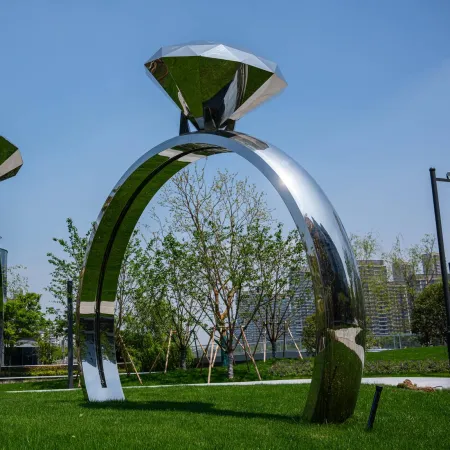
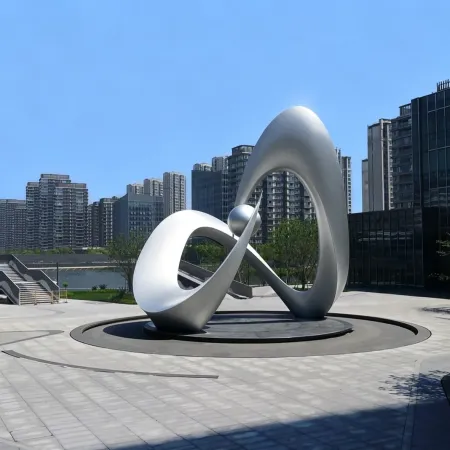
Public space art sculpture brings something no mural, light installation or landscape work quite matches: a physical presence in the round, an object that occupies real space and changes as the viewer walks around it. A sculpture declares itself as an object with volume, weight and material truth, and that declaration creates a different relationship with the public, one of encounter rather than backdrop. People do not only look at sculpture; they circle it, touch it, measure themselves against it and remember its physicality.
Sculpture also carries the deepest history of public art, from the monuments of antiquity to the landmarks of modern cities, and that lineage gives a sculptural commission a weight of expectation. A public sculpture is judged against every sculpture the viewer has ever seen, so its proportions, its material and its craft must satisfy a standard that has been refined over millennia. This is why public space art sculpture is best entrusted to studios with genuine sculptural training rather than to general fabricators who happen to work in metal.
Designing a Sculpture for the Public Realm
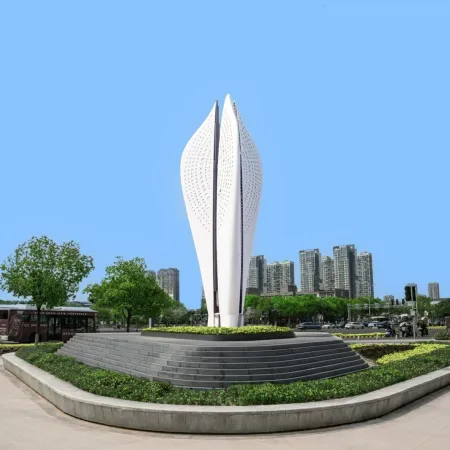
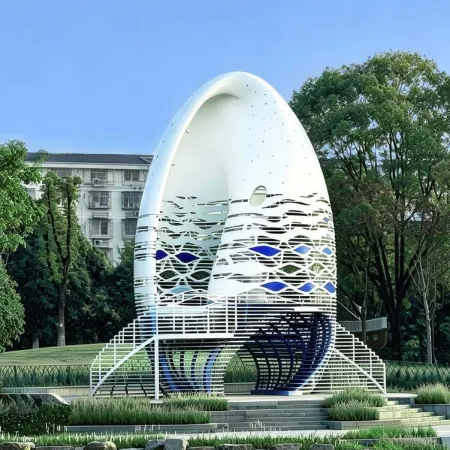
The design of public space art sculpture begins with the same questions as any public work, the site, the users, the scale and the meaning, but it adds the sculptor's particular concerns. The form must work in the round, rewarding the viewer who walks around it and not only the one who faces it; the silhouette must read against the sky and the buildings; the surface must carry interest at close range; and the relationship between the sculpture and the ground, its base, its shadow and its place among people, must be composed as part of the work.
A public sculpture also has to survive the social life of its site. It will be leaned on, photographed against, climbed by children where the design invites it and used as a meeting point, and the design should anticipate these uses rather than suffer them. We consider how the sculpture will be touched, sat beside and lived around, and we design the base, the edges and the materials so that the work welcomes its public life without being diminished by it.
| Sculptural concern | What the sculptor resolves | Why the public feels it |
|---|---|---|
| Work in the round | Every angle composed, no dead views | People circle the work and keep discovering |
| Silhouette | Outline composed against sky and city | The work reads from far and near |
| Surface | Material truth and finish at close range | The work rewards touch and inspection |
| Base and ground | The sculpture's relation to its ground | The work belongs to its place, not floats in it |
Material and Craft: The Sculptor's Vocabulary
Material is the sculptor's vocabulary, and the choice for public space art sculpture is made between the artistic possibilities of each medium and the realities of the public site. Bronze carries tradition and warmth, developing a patina that ages with dignity; stainless steel brings the mirror of the present and extraordinary longevity; weathering steel speaks the language of landscape and time; and aluminium allows forms that are light, coloured and dynamic. Each material has its own craft, and a studio should be fluent in the ones it proposes.
The craft of making is where sculpture in public space is won or lost. A bronze must be cast, welded and chased so the surface reads as one continuous form; a mirror-polished steel must be finished so the reflection is true and the seams invisible; a weathering steel must be detailed so it rusts evenly and does not stain the paving; and every material must be protected through transport and installation. Our workshop performs these crafts in-house, so the sculptors who design the work are the same people who must make it worthy of the name.
Engineering the Sculpture to Stand for Generations
The engineering of public space art sculpture is the invisible half of its permanence. The internal structure must carry the weight of the form and its loads without betraying the silhouette; the foundation must transfer those loads to the ground safely; the wind must be analysed for forms that catch it; and the fixings must resist the corrosion and fatigue of decades. A sculpture that fails structurally is not only a lost artwork but a public danger, so the engineering is never an afterthought.
Because our designers and engineers work in one studio, the structure is developed with the sculpture rather than imposed on it. A cantilever that needs hidden counterweight, a kinetic joint that needs a bearing housing, a tall form that needs internal stiffening, all of these can be resolved invisibly when the engineer understands the artistic intent. The public sees only the form, and the success of the engineering is measured by how completely it disappears.
Commissioning a Public Space Art Sculpture
The commissioning of public space art sculpture should seek a studio with both artistic lineage and manufacturing depth, because the work demands both. Ask about the studio's training and its collaborations with recognised artists, because those connections shape the artistic judgment behind the forms; then verify the workshop, the engineering and the quality records, because that judgment is worthless if the making cannot honour it. The studios that combine both are rare, and they are the only safe home for a serious sculptural commission.
The brief itself should treat the work as sculpture rather than as placemaking furniture. Describe the site, the community and the feeling the place should carry, but leave the artistic form open; name the material possibilities honestly with the climate in mind; and allow the concept stage the room to explore, because the sculpture the community ends up loving is rarely the one the brief imagined. A public sculpture is a gift to the future, and the commissioning should give it the freedom to be art.
Sculpture Commissioning Checklist
- Seek artistic lineage and manufacturing depth together, not one without the other.
- Leave the artistic form open in the brief and let the concept explore.
- Judge the work in the round, from every angle, not only the hero shot.
- Verify the material craft on samples before production.
- Approve the engineering package as part of the design gate.
What a True Public Sculpture Delivers
A work of art that rewards every walk around it
A material presence that ages with dignity
An engineering that disappears into the form
A landmark the community protects as its own
Frequently Asked Questions About Public Space Art Sculpture
What makes a public sculpture different from other public art?
A sculpture occupies space in the round, demanding composition from every angle, material truth and a physical presence that creates encounter rather than backdrop.
Which material lasts longest in public space?
Stainless steel in the right grade offers extraordinary longevity, while bronze and weathering steel age with character where their maintenance and site conditions are respected.
Why is sculptural training important in a maker?
Because public sculpture is judged against the whole history of sculpture, and the training shows in proportion, form and surface judgment that no fabrication skill alone can supply.
Can a public sculpture be interactive or kinetic?
Yes, and some of the most loved public sculptures move, light up or respond, as long as the interactive engineering is designed to public standards and maintainable for decades.
How do I know a studio can make what it designs?
Verify the workshop in person or by video, audit the quality records, approve material samples and contact the owners of works the studio delivered end to end.
Public space art sculpture is the art form that asks the most of its makers and gives the most to its city, a physical presence that generations will circle, touch and remember. Commission it from a studio that unites artistic lineage with manufacturing depth, and the work will stand as sculpture first and landmark always.
If you are considering a public space art sculpture, we will show you works in the round, introduce you to the artists behind our studio and walk you through the workshop where the forms are made.