How a Large Public Art Sculpture Changes the Space Around It
A large public art sculpture does more than decorate a space; it redefines the space, giving a plaza a centre, a skyline a marker and a district an identity that people use to give directions. Scale is the most powerful tool in public art because it changes perception itself, and a work bold enough to compete with its surroundings can turn an anonymous stretch of urban land into a destination.
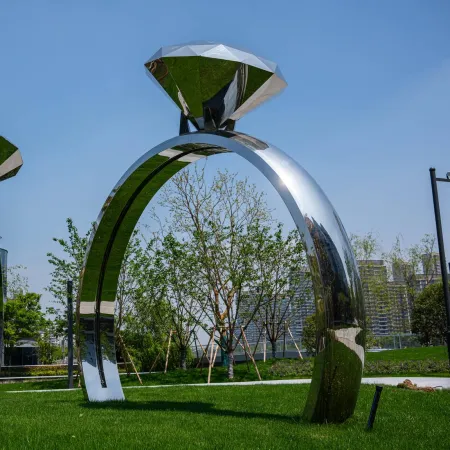
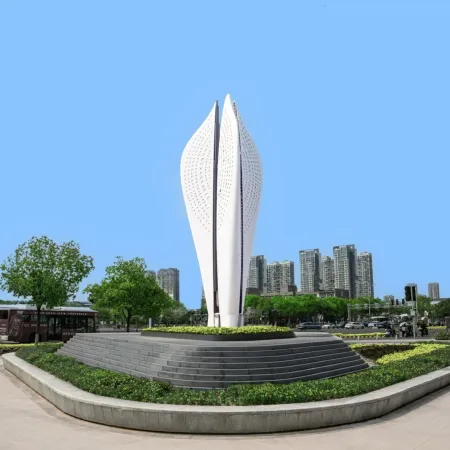
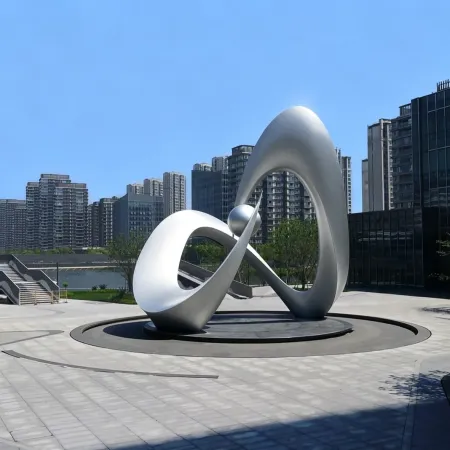
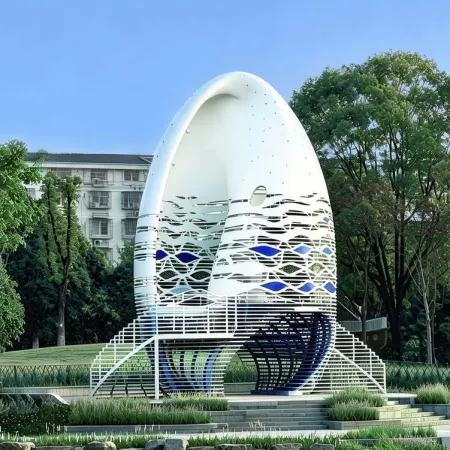
This guide explains what makes a large public art sculpture succeed, the site and engineering decisions that large scale demands and how to commission a monumental work without letting the process overwhelm the project. Our studio has delivered works up to 47 metres across, including landmark pieces such as a 20.8-metre stainless steel gateway and a 12.8-metre interactive seashell, so the guidance below is grounded in works that have changed real places.
See the monumental range in the project gallery, the full capability in our services and a large gateway work like Peach Blossom.
Why Scale Works When It Is Earned
A large public art sculpture earns its size when the scale answers the space rather than the ego. In a vast plaza, a modest sculpture is visually swallowed, its details lost to distance, while a monumental form gives the eye somewhere to land and the crowd somewhere to gather. Scale also carries meaning: a gateway marks passage, a tower marks arrival and a canopy marks shelter, and the most successful large works match their size to a role the place actually needs.
But overscaled work fails just as surely as underscaled work. A sculpture that ignores its sight lines can block a view the city values, dwarf a historic building or create a shadow that kills the life of a square. The discipline of large public sculpture is proportion, and the studio must study the space from the distances people will actually experience it, the street corner, the building entrance and the far side of the plaza, before it proposes a dimension.
| Viewing distance | What the design must carry | Common failure |
|---|---|---|
| Far (400m+) | Bold silhouette, clear profile | Fine detail lost entirely |
| Middle (50-150m) | Surface rhythm, material logic | Flat, featureless planes |
| Close (under 10m) | Weld quality, finish, texture | Rough joins seen up close |
| Beneath | Shelter, shadow, underside care | Neglected underside and base |
Engineering a Monument That Stands and Moves Well
The engineering of a large public art sculpture is closer to bridge building than to studio craft, because the structure must carry its own weight, resist the wind over a huge surface area and stand on foundations that the ground can actually support. Wind analysis is critical for tall and open forms, since a large surface can generate forces that surprise the unwary, and the internal frame must transfer those loads cleanly to the base without visible bracing that ruins the design.
Sectioning is the other great engineering act of monumental work. A 20-metre sculpture cannot travel as one piece, so the design must divide into sections that fit the transport route and the site access, with joints that disappear in the assembled form. The studio plans the lifting sequence, the temporary propping and the on-site alignment so that sections that left the factory in separate trucks become one seamless work in the air, and that choreography is where large sculpture either impresses or embarrasses.
The Site Conversation: Landmark or Intrusion
A large public art sculpture enters a conversation with everything around it, and the studio must listen before it speaks. The work should respect the architectural language of the district without repeating it, acknowledge the views that matter without blocking them and understand the daily rhythms of the space, the market that sets up in the morning, the commuters who cross at six, the festival that fills the square twice a year. A monumental work that ignores those rhythms becomes an obstacle; one that reads them becomes a partner.
Community and authority engagement is proportionally more important at monumental scale, because the work will dominate the public realm for generations. Presenting the concept early, explaining the meaning and listening to the response builds the consent that a large intervention needs, and it often improves the design. The studios that succeed with landmarks treat the approval process not as a hurdle but as part of the design conversation, and the works that result belong to the community from the day they are proposed.
- Answer the space with a scale the place truly needs.
- Design for three distances, silhouette, surface and seam.
- Engineer like a bridge, wind, loads and foundations.
- Plan the sectioning before the first steel is cut.
- Engage early with the community and the authorities.
What Monumental Scale Delivers
A centre and a marker for the space
Identity a district can rally around
Photographs that market the city
A destination that draws people in
Delivery: Foundations, Transport and the Lift
Delivering a large public art sculpture is a logistics project in its own right, and the plan must start long before fabrication. The foundation design must reach the local engineer early enough to be poured and cured on schedule, with anchor positions toleranced against the fabricated base. The transport route must be checked for bridge heights, turning radii and road weights, and the site access must be confirmed for the size of the vehicles and the crane that will make the final lift.
The installation itself is a choreographed sequence of lifting, aligning and fixing, often with the largest section placed first and the smaller pieces built around it. Experienced crews work from a written plan with rigging points designed into the sculpture and lifting lugs that are later concealed or removed. When the last section is seated and the fixings are torqued, the work receives its final alignment check and the scaffolding comes down to reveal the monument, the moment every large public art sculpture project works toward.
Coordinating With the Landscape and the Architecture
A large public art sculpture performs best when it is designed in concert with the landscape and the architecture around it, rather than dropped into a finished space as an afterthought. The most successful monumental projects bring the sculptor into the same conversation as the landscape architect and the building architect, so that the sculpture's foundations align with the paving grid, its lighting shares the site's electrical planning, its base relates to the planting and the seating, and its form answers the architecture without repeating it. Coordination of this kind is what makes a landmark feel inevitable rather than imposed.
The practical dividends of early coordination are as valuable as the aesthetic ones. When the sculpture is designed together with the site, the foundation can be cast once to the right position, the service ducts can be routed before the paving is laid and the crane plan can use access that the landscape design preserves. Retrofitting a monumental sculpture to a finished plaza, by contrast, means cutting finished paving, relocating planting and negotiating with systems that were never designed to receive it. Clients who involve the sculpture studio at the masterplan stage receive a work that belongs to its place and a site that was built to host it, and that integration is worth far more than the coordination it costs.
A monumental work also deserves a story that travels with it, because a landmark that is explained is a landmark that is loved. The client should plan the narrative at the same time as the sculpture: the meaning of the form, the name of the artist or studio, the history of the site and the stories of the community, told through a plaque, a page on the owner's website, a guided tour stop or a short film of the making. That story multiplies the value of the work, giving journalists something to write, teachers something to explain and residents something to repeat with pride. We often help clients capture the fabrication and installation on film, because the making of a monumental sculpture is itself a spectacle, and the record of it becomes part of the legend of the landmark.
Frequently Asked Questions About a Large Public Art Sculpture
How large should a public sculpture be?
Large enough to hold the space and carry its role as a marker or landmark, but proportioned against the sight lines, architecture and daily life of the site.
How is a monumental sculpture engineered?
Like a bridge: wind and load analysis, foundations sized for the ground, and an internal structure that transfers forces to the base without visible bracing.
How does a 20-metre sculpture reach its site?
It is fabricated in transportable sections, shipped to the site and assembled with a planned lifting sequence so the joints disappear in the finished form.
Does large scale mean long delivery time?
Monumental works need time for engineering, fabrication, foundations and installation, so a realistic schedule that runs approvals beside making protects the project.
What makes a landmark loved rather than resented?
Scale that answers the space, meaning the community understands and early engagement that lets residents meet the concept before it becomes steel.
A large public art sculpture changes the space around it when the scale is earned, the engineering is rigorous and the delivery is choreographed. Study the site from every distance, engineer like a bridge builder, section for the road and engage the community early, and your monument will be adopted rather than endured.
If you are imagining a large public art sculpture for your city or campus, bring us the site and the ambition and we will help you test the scale, the meaning and the route to standing.