Inside the Workshop of a Serious Urban Art Installation Manufacturer
Behind every landmark that defines a city skyline stands a workshop, and choosing the right urban art installation manufacturer is the quiet decision that decides whether a brilliant design becomes a durable icon or a costly disappointment. The manufacturer's craft turns drawings into welded reality, and its systems decide whether that reality matches the approved model to the millimeter, survives its first inspection and still stands true in its thirtieth year. Yifeng Sculpture Studio has operated as an urban art installation manufacturer since 2003, delivering works to more than twenty countries, and this guide opens the workshop door to show the disciplines, equipment and quality systems that serious urban fabrication demands.
The sections below cover workshop capability, fabrication planning for urban scale, quality systems, surface and finish control, production scheduling and the manufacturer's role in international delivery.
A manufacturer is measured differently from a designer: the designer sells a vision, but the manufacturer sells the certainty that the vision can be built — on schedule, to tolerance, and in a way that survives the city's hardest decades. The workshop is where that certainty is either earned or lost.
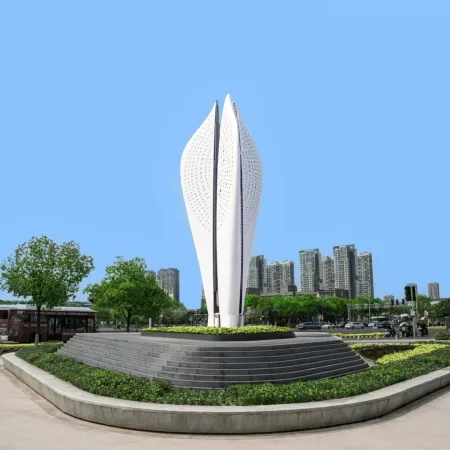
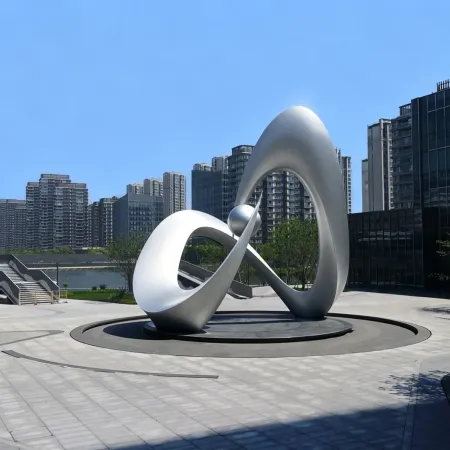
The services overview shows how our workshop fits into the full commission pipeline, the project archive documents the manufactured results, and Fishing Net Canopy demonstrates fabrication at a structural scale that only a serious workshop can deliver.
Workshop Capability: What Urban Fabrication Actually Requires
Urban art installation manufacturing demands a workshop that behaves like a small structural-steel fabricator with an artist's standards. The floor must handle heavy plate and long members; cutting and forming equipment must hold tolerances that architectural work rarely demands; welding capacity must cover structural joints certified to public-safety standards; and the finishing bays must produce surfaces that will be inspected daily by an entire city. A manufacturer's real capability is visible on the floor — in the size of its handling equipment, the discipline of its welding stations, the condition of its finishing areas and the presence of a trial-assembly space large enough to dry-fit a landmark before it ships. We welcome clients and their inspectors to our floor for exactly this reason: the workshop is the evidence.
Fabrication Planning: The Module Strategy Behind Every Landmark
Urban-scale works are too large to build, ship and lift as single objects, so the manufacturer's first engineering act is the module strategy: where the form is divided, how the seams hide, how the pieces pack into transport and how the crane sequence reassembles them on site. The module plan is decided during engineering, never improvised at the workshop door, because every seam is a visual and structural decision. We cut and form each module against the 3D model, hold the interfaces to tolerance, and prove the whole assembly in a full trial dry-fit before anything is finished or packed. A landmark that has been assembled once in the workshop arrives on site as a confirmation; one that is assembled for the first time on site arrives as a gamble.
| Workshop Stage | Control Applied | Risk Removed |
|---|---|---|
| Cutting and forming | Tolerance checks against the 3D model | Geometry drift before it compounds |
| Welding | Certified procedures, weld inspection records | Structural failure and hidden defects |
| Trial assembly | Full dry-fit of every module before finishing | Site-day fit failures and rework |
| Finishing | Approved samples, controlled application | Color and surface mismatch across modules |
Quality Systems: The Boring Machinery That Protects the Art
Urban landmarks are too public and too permanent to be protected by goodwill, so a serious urban art installation manufacturer runs on documented quality systems. Material certificates are traced to each order; weld inspections are recorded against named joints; finish samples are approved before production and retained as the benchmark; and every production batch moves through checkpoints with sign-off before it advances. These systems sound administrative, but they are what make quality repeatable across a twelve-module landmark fabricated over many months — the same standard applied in week one and week twenty-six. When a manufacturer's records are open to client inspection, the artwork is protected by evidence rather than by assurances, which is exactly the protection a fifty-year public investment deserves at every stage of production.
What Our Studio Delivers as an Urban Art Installation Manufacturer
A workshop capable of structural-scale fabrication with artist-level finish standards
Module strategies and trial assemblies that make site day a confirmation
Documented quality systems open to your own inspection at every stage
Surface and Finish Control at City Scale
A city inspects finishes daily, which makes surface control one of the manufacturer's highest-stakes disciplines. Mirror stainless must read as one continuous sky across modules fabricated weeks apart; painted surfaces must match the approved color under the site's actual light; brushed direction must run consistently so panels do not look patched. We achieve this through controlled processes — finish samples made with production parameters, color standards retained for comparison, surface protection between fabrication and installation, and touch-up protocols that repair transit damage invisibly. The finishing bays are where a manufacturer's pride is most visible, and where the difference between a landmark that looks machine-made and one that looks hand-perfected is decided every day.
The workshop's role also extends to protecting the artwork after it leaves the floor. Export packing for urban-scale modules is engineered around the specific risks of ocean and road transport — cushioning against shock, bracing against movement, weather protection against the journey's climates and clear handling marks for every stage. We photograph each module as it is packed so the record shows the condition at departure, and we provide the site team with an unpacking and inspection protocol that catches any transit issue while responsibility is still clear. A serious urban art installation manufacturer treats the journey as an extension of the workshop, because a landmark that arrives damaged is not just a repair problem — it is a schedule problem, a quality problem and a trust problem, all of which disciplined packing prevents before they begin.
Production Scheduling and International Delivery
Urban projects arrive with deadlines tied to construction programs, civic calendars and funding cycles, so the manufacturer's production schedule is a promise that must be kept. Serious fabrication planning sequences cutting, forming, welding, finishing and trial assembly against real milestones, identifies the critical path early and communicates delays the day they appear, with options rather than excuses. For international delivery, the same planning extends to export packing engineered for the journey, transport routes sized for each module and a method statement the site team can rehearse before the crane arrives. Across more than twenty countries, we have learned that the manufacturer who plans the schedule as carefully as the welds is the manufacturer whose landmarks open on time, season after season, delivery after delivery.
Frequently Asked Questions About Urban Art Installation Manufacturers
What should we look for when visiting a manufacturer's workshop?
Look at the floor, not the brochure: handling equipment sized for large work, welding discipline, finishing standards, a trial-assembly area and the housekeeping that reflects craft. Then ask for the quality records from a completed urban project and review them with your own engineer.
How do manufacturers keep quality consistent across a large multi-module work?
Through documented systems: material traceability, weld inspection records, approved finish benchmarks and checkpoint sign-offs at every production stage. Consistency is engineered by process, not achieved by mood, which is why the same standard applies in week one and week twenty-six.
Can a manufacturer handle the engineering too?
The strongest manufacturers do — engineering and fabrication under one roof removes the handoff gaps where drawings get misinterpreted and responsibility gets diluted. We engineer every work we fabricate so the shop drawings, the structure and the workshop speak one language.
How far in advance should a manufacturer be involved?
As early as the design exists in concept form. Involving the manufacturer during design lets module strategy, material reality and transport constraints shape the artwork instead of fighting it — the cheapest fabrication is the fabrication planned before the design hardens.
What makes a manufacturer reliable for international projects?
Documented quality systems, honest scheduling, engineered export packing and a supervised installation method statement — plus a track record of delivered international work. Reliability is proven by references from clients who received their landmarks on time and intact.
Choosing an urban art installation manufacturer is choosing who will hold the tolerance, the schedule and the quality standard of your most visible investment — and the workshop tour, the quality records and the reference calls above are how that choice is made with evidence rather than hope. The manufacturer who opens its floor, its files and its finished landmarks is the manufacturer who has nothing to hide and everything to prove. If your city's next landmark is on the drawing board, put our workshop to that test — we have been manufacturing urban art installations since 2003, and we are ready to show you why cities across more than twenty countries trust this urban art installation manufacturer with the works that define them.