What a Custom Interactive Sculpture Manufacturer Must Engineer In
A custom interactive sculpture manufacturer is building a machine that must look like a work of art and behave like a public appliance. Sensors, controllers, drives and lights all have to survive weather, vandalism and years of daily use while remaining invisible to the experience. When the interaction reads as magic, an enormous amount of engineering has been hidden; when it reads as a machine, not enough has been.
Yifeng Sculpture Studio has produced kinetic and interactive public works since 2003, with more than 3000 delivered works across 23 countries. Projects such as our large interactive landmarks have taught us that the technology is rarely the hardest part. The hardest part is designing an interaction that still works in the rain, in the wind, in the dark and in the hands of a curious eight-year-old.
Designing the Interaction Before the Hardware
Interaction design should come first. What will a visitor do when they approach? Will the work respond to movement, sound, touch or simply presence? How long should the response last, and what happens when twenty people arrive at once? Answering those questions on paper saves money later, because the sensor and controller selection follows directly from the behaviour, and a manufacturer that starts by buying hardware is building backwards.
The best interactions are legible within a few seconds. A visitor should understand what to do without instructions, and the response should be generous enough to reward a small gesture. Subtlety is a virtue in art and a liability in interaction, because a public work that only responds to precise movement will be read as broken. A custom interactive sculpture manufacturer should prototype the sensing and test it with real people before the sculpture is fabricated.
| System | Engineering requirement | Failure mode if ignored |
|---|---|---|
| Sensing | Housing rated for the site, with redundancy in the trigger logic | The work stops responding and is read as broken |
| Motion | Drives sized with margin, bearings sealed and serviceable | Seized bearings and a stalled movement |
| Control and power | Protected enclosure, surge protection and accessible drivers | Water ingress and a dead installation after a storm |
| Light and sound | Fixtures rated for continuous outdoor duty and reachable for service | Dark spots and a work that dims unevenly |
Weatherproofing, Safety and Fail-Safe Behaviour
Outdoor interaction lives or dies on enclosure design. Sensors, controllers and power supplies must sit in housings rated for the site, with cable entries that face downward, gaskets that can be replaced and drainage that does not rely on a perfect seal. Condensation is the silent killer of outdoor electronics, so ventilation, desiccant or a controlled heater may be needed depending on the climate. These details are unglamorous and decisive.
Safety engineering is not optional in a public place. Moving parts must be guarded or limited in force, pinch points must be eliminated, edges must be radiused and the controls must fail safe, meaning that a lost sensor, a power cut or a software fault leaves the work in a safe and quiet state rather than a dangerous one. A custom interactive sculpture manufacturer should document the interlocks, the limits and the emergency stop, and should demonstrate them at commissioning.
- Sealed enclosures: housings, gaskets and downward cable entries chosen for the real exposure rather than the catalogue average.
- Force limits: drives and mechanisms sized so that a person cannot be injured even if the control logic fails.
- Fail-safe default: the work returns to a safe, still, unlit state whenever a fault or outage occurs.
- Documented interlocks: every limit switch, sensor check and emergency stop recorded and demonstrated at handover.
- Vandal resistance: fixings, panels and lenses chosen on the assumption that they will be tested by the public.
Commissioning and the First Season
Commissioning an interactive work is a performance test as much as a safety test. The manufacturer should run the work through its full cycle, verify every response, confirm the behaviour at the extremes of temperature and light and observe the first public encounters. What the designer assumed and what visitors actually do are often different, and the gap is easiest to close while the work is new and the programme can still be adjusted.
The first season should be treated as a tuning period. The owner's team keeps simple notes on when the work draws crowds, which gestures people discover and whether any element is overused or ignored, and the manufacturer reviews those notes and refines the programme. Some of the most successful interactive works evolve year by year, gaining new sequences and responses as their communities grow into them. A custom interactive sculpture manufacturer who plans for that evolution delivers a work that stays alive.
The Engineering Behind the Magic
An interaction a visitor understands in seconds
Electronics that survive rain, frost and heat
A safe, quiet state whenever anything fails
A programme that can be tuned after opening
Maintenance, Access and the Cost of Ownership
An interactive work has a running cost, and it should be estimated honestly at the design stage. Lamps and drivers have service lives, bearings need lubrication, filters and seals need replacement and software needs occasional attention. None of that is a reason to avoid interactivity; it is a reason to design for service, with panels that open without dismantling the artwork and components that a local technician can replace with standard parts.
Access is the detail that decides whether those costs stay reasonable. If the controller is behind a welded panel, every fault becomes a major operation; if it sits in a lockable compartment at ground level, a fault is a fifteen-minute visit. A custom interactive sculpture manufacturer should present the maintenance plan as part of the proposal, name the intervals and show the access strategy on the drawings, so the client can budget for the work's whole life rather than just its opening.
- Prototype the sensing: test the interaction with real visitors before committing to the final hardware and enclosure.
- Design for service: controllers, drivers and bearings positioned so routine work needs a ladder, not a crane.
- Train the owner's team: daily checks, first-line fault finding and the point at which a specialist should be called.
- Plan the tuning: a review after the first season to adjust sensitivity, timing and sequences based on real use.
- Keep the software documented: source, settings and the change history handed over so the work is not locked to one supplier.
Working With the Client's IT and Facilities Teams
An interactive work touches systems that belong to other people. It needs power, sometimes a data connection, occasionally an interface with the building management system and always a maintenance routine that the facilities team can follow. Bringing those teams into the conversation early avoids the common situation where a completed installation cannot be commissioned because nobody has agreed who supplies the supply or who owns the software.
The questions to settle are practical. Where does the power come from and who isolates it for service? Is there a network connection, and if so what is it allowed to do? Who holds the software, the settings and the passwords? What happens if the manufacturer is no longer available in ten years? A custom interactive sculpture manufacturer should raise all of these in writing, because the answers determine whether the work can be maintained by the owner or only by its maker.
Frequently Asked Questions About a Custom Interactive Sculpture Manufacturer
How do you keep electronics alive outdoors?
With rated enclosures, downward cable entries, replaceable gaskets, drainage that does not depend on a perfect seal and, where needed, ventilation or heating to control condensation.
What happens if the power fails or a sensor dies?
The work falls back to a safe, still, unlit state by design, and the interlocks and limits are documented and demonstrated at commissioning.
Can the interaction be changed after installation?
Yes, and it usually should be. We plan a review after the first season and can refresh sequences, sensitivity and timing as the site's use becomes clear.
How much maintenance does an interactive work need?
It varies with the mechanism, but we set out the intervals and the likely component lives in the proposal so the owner can budget for the whole life of the work.
Do you hand over the software and settings?
Yes. Source, configuration and the change history are part of the handover, so the owner is never locked to a single supplier for future work.
A custom interactive sculpture manufacturer is really engineering an experience that must survive the real world. The interaction has to be obvious, the hardware has to be sealed, the behaviour has to fail safe and the programme has to be adjustable once real people arrive. Get those four right and the technology disappears, leaving a work that people return to with their friends.
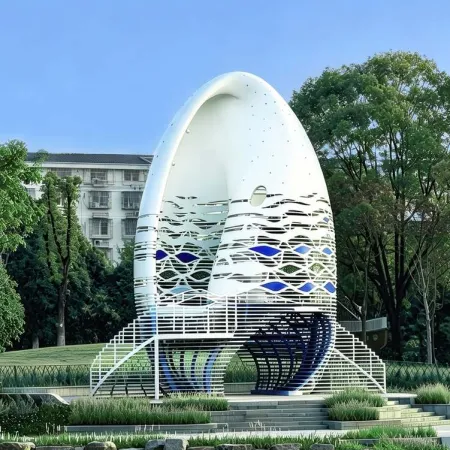
See interactive and kinetic work in the project gallery, understand the full delivery chain in the services overview, and look at Hello Conch, a 12.8 metre interactive landmark where every system had to be engineered to be forgotten.
Describe the behaviour you want and the site it will live in, and we will tell you what it takes to make it reliable. A custom interactive sculpture manufacturer who shows you the enclosures, the interlocks and the maintenance plan is one whose magic will still work in year five.