How a Garden Stainless Steel Sculpture Changes With the Seasons
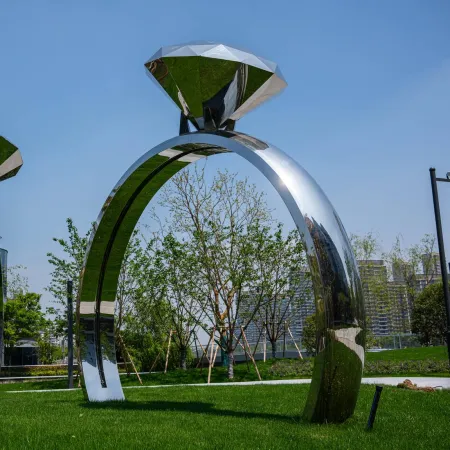
A garden stainless steel sculpture earns its place by reflecting the garden rather than competing with it. Because the surface mirrors planting, sky and changing light, the same object can look cool and quiet in winter, warm and green in summer and almost luminous at dusk. That responsiveness is why stainless works so well in planting schemes: it does not add another colour to an already rich palette, it gathers the colours that are already there and returns them to the viewer.
Yifeng Sculpture Studio has produced garden and landscape sculpture since 2003 among more than 3000 delivered works in 23 countries, and we have learned that the garden is a demanding setting in its own way. The scale is intimate, the viewpoints are close, and the piece will be seen every day by the same people. In a private garden a sculpture is not a landmark to be visited but a companion to be lived with, and that changes how it should be designed, finished and sited.
Siting a Garden Stainless Steel Sculpture
Placement in a garden is a matter of views, and there are usually three that matter. The first is the view from the house, which is the one the owner will see most often and which should be composed from the main windows. The second is the approach along a path, where the work should reveal itself gradually rather than stand fully exposed from the start. The third is the close view, where the surface and the detailing have to hold up to inspection. A piece that satisfies only one of these will eventually feel misplaced.
Light and planting do the rest. A polished form placed against a dark evergreen backdrop will read as a bright interruption, while the same form against an open sky may almost disappear. A matt or brushed surface sits more calmly among flowers, whereas a mirror finish creates movement and light where the planting is quiet. We ask clients to photograph the site at different hours and in different seasons before the design is fixed, because a garden changes more through the year than almost any other setting.
| Position | Effect | Best suited finish |
|---|---|---|
| Focal point at a path end | Draws the eye and gives the walk a destination | Mirror polish for maximum presence |
| Beside water | Doubles the reflection and the movement of light | Polished or satin, with a suitable grade |
| Among dense planting | Appears and disappears as the borders grow | Brushed or blasted, to sit calmly |
| On a lawn, freestanding | Reads against sky and grass from every angle | Any finish, but proportion is critical |
| On a terrace or patio | Seen at close range and touched daily | Satin or brushed, tolerant of contact |
Scale, Proportion and the Private View
Scale in a garden is relative, and the most common mistake is choosing a piece that is too small for the space or too large for the planting. A sculpture that is dwarfed by a mature tree looks like an ornament, while one that overwhelms a border destroys the composition it was meant to complete. The right size is usually determined by the distance from which it will most often be seen: a work viewed from a window needs more presence than one encountered on a path, where the viewer is close and the detail does the work.
Proportion also governs how the piece relates to the ground. A slender vertical form needs a base that anchors it visually, and a low horizontal form needs enough mass to hold its position without looking like furniture. We test these relationships with simple mock ups on site, using a light frame at the proposed height and footprint, because a garden is a place of intuition and the client usually knows within seconds whether the scale is right once they can see it standing there.
- Design from the house: the composition should work from the windows the owner uses every day.
- Stage the approach: let the work reveal itself along the path rather than standing exposed at once.
- Match the backdrop: consider whether the piece will read against foliage, sky, wall or water.
- Test the scale on site: a simple frame at the proposed height settles the question faster than any drawing.
- Plan for growth: allow for hedges, trees and borders that will change the view over ten years.
What a Garden Work Needs
A composition that works from the house and the path
A finish chosen for the light and the planting around it
A base detail that anchors the form without fuss
Durability to weather decades of outdoor life
Materials, Bases and Long Term Care
For garden use, grade selection follows the same logic as any outdoor site. Inland gardens with no salt exposure are usually well served by grade 304, while a garden near the coast should move to a higher alloy and a shorter cleaning interval. Water features deserve particular care, since a chlorinated or salt laden pool will attack the steel where it enters the water, and the interface should be detailed so that splash and immersion do not create permanent wet zones against the surface.
The base is often an afterthought and should not be. A concealed base that sits just below turf level keeps the sculpture reading as though it grew from the ground, while a visible plinth changes the work into an object on display. Drainage around the base matters too, because soil held against stainless keeps it wet and can start the very corrosion the grade was chosen to avoid. We detail the foundation, the drainage and the fixing as part of the design rather than leaving them to the landscape contractor.
- Choose the grade for the location: standard grades inland, higher alloys where salt or chlorinated water is present.
- Detail the base: conceal it where possible, and never allow soil to sit permanently against the steel.
- Manage water: drain away from the base and keep sprinkler or irrigation spray off the surface.
- Wash seasonally: a simple routine of fresh water and mild soap keeps the finish bright through the year.
- Protect from garden chemicals: fertiliser, lime and pool chlorine should not be allowed to splash onto the surface.
Light, Planting and the Garden Stainless Steel Sculpture
A garden stainless steel sculpture is really a device for gathering light, and the planting around it determines what that light contains. Surrounded by herbaceous borders, a polished surface carries the colours of flowers and foliage into the work; placed against an evergreen hedge, it becomes a bright counterpoint that holds through the winter. The same piece can look entirely different in two parts of the same garden, which is why placement matters as much as design.
Seasonal change is part of the pleasure. In spring a reflective form catches the new growth, in summer it holds the deep greens and the high light, in autumn it takes on warmer tones, and in winter, when the borders are cut back, it stands clear against the structure of the garden. A garden stainless steel sculpture sited with those changes in mind becomes more interesting through the year rather than less.
Lighting extends the work into the evening, which is when many gardens are actually enjoyed. Uplighting a form from the base gives it a different character than lighting it from the side, and a polished surface will reflect whatever is aimed at it, including the fittings themselves. We recommend testing the lighting with the sculpture in place, because the interaction between surface, planting and light cannot be predicted from a plan.
Maintenance in a garden is usually light, but it should be planned around the planting calendar. Irrigation spray can leave mineral deposits, fertiliser and lime can mark the surface, and leaf litter can hold moisture against the base. A seasonal wash after the main growing period, and a check that irrigation does not play directly onto the work, keeps a garden stainless steel sculpture looking as intended through the years.
Frequently Asked Questions About Garden Stainless Steel Sculpture
Will a mirror finish look too cold in a garden?
It can in a very green, enclosed space, which is why a brushed or blasted finish often suits planting better, but a polished piece against sky or water can be extraordinarily effective.
Can it be moved later if we redesign the garden?
Yes, if the base and fixings are designed for it, and we recommend discussing relocation at the design stage so the connection does not have to be cut out later.
How much maintenance does it need?
Very little in a clean inland garden, and rather more near the sea or under trees, where a seasonal wash removes the deposits that would otherwise dull the surface.
Is stainless safe near a pond?
Stainless is generally suitable, but the grade should account for any salt or chlorine in the water, and the detail should keep the water line from becoming a permanent crevice.
Do you work with private garden designers?
Frequently, and the best results come when the sculptor and the planting designer agree the scale, the placement and the finish before either commits to a layout.
Our full delivery process is set out in the services overview, and a landscape project where a sculptural form sits within planting is Joy of Fenghua River. Further landscape and garden scale work appears in the project gallery.
Send us photographs of the site through the year and tell us how you want it to feel, and we will propose a scale, a position and a finish. Sited and finished with that care, a garden stainless steel sculpture becomes the one element in the garden that is never out of season.