Why Site-Specific Sculpture Design Creates Works That Cannot Live Anywhere Else
Site-specific sculpture design begins with a simple discipline: the work must be conceived for one particular place so completely that it could not move to another without losing its meaning. Where a portable sculpture carries its own world and can sit anywhere, a site-specific work draws its life from the ground, the light, the history and the people of its one location, and that rootedness is its deepest power.
Yifeng Sculpture Studio has practised site-specific sculpture design since 2003, delivering more than 3000 works across 23 countries. Our site-specific works grow from deep study of each location, and our artistic roots in the China Academy of Art, the Academy of Arts & Design at Tsinghua University and the Royal Society of Sculptors teach us to read the layers of meaning a place already carries.
What Makes a Design Truly Site-Specific
Site-specific sculpture design is not simply placing a sculpture on a site; it is drawing the sculpture out of the site. The designer studies the place's physical character, its light and weather, its architecture and landscape, and its invisible layers of history, memory and daily life, and the concept emerges from that reading. A work is site-specific when the site itself is half the author, when removing the work from its place would be like removing a word from a sentence.
The test of site-specificity is simple and severe. If the concept could be installed in another plaza, another park or another city without significant loss, it is not yet site-specific, however well it fits its present location. The designer must therefore resist the comfortable habit of reusing a successful form, because every site demands its own conclusion, and the discipline of beginning fresh with each place is what keeps the work honest.
The Layers of Meaning a Site Carries
The table below sets out the layers a site-specific sculpture design reads in every location, from the physical to the invisible. Each layer is a possible source of the concept.
| Layer | What the designer reads | How it shapes the work |
|---|---|---|
| Physical | Light, weather, ground, views | Form and material answer the place's conditions |
| Historical | Events, people, memory of the place | The work carries what the place has been |
| Architectural | Buildings, materials, scale around the site | The form converses with the built context |
| Social | Who uses the space and how | The work serves the daily rituals of the place |
| Cultural | Identity, traditions, local character | The work speaks the community's own language |
How a Site-Specific Concept Is Discovered
The discovery of a site-specific concept is part research and part intuition. We begin by visiting the site at different hours, walking its approaches, feeling its scale and watching how people use it, and we dig into its history, its name, its stories and its future plans. We then hold the findings loosely while the artists respond, because the strongest concepts often arrive as unexpected connections between the site's layers rather than as obvious illustrations of them.
The client and the community are part of the discovery. We listen for the stories the place tells about itself, the memories it holds and the hopes its people carry, and we test our emerging directions against that local knowledge before developing them fully. A site-specific work that the community recognises as its own has already succeeded, because recognition is the beginning of adoption, and adoption is the beginning of love.
The Discipline of Designing for One Place
- Resist the reusable: the designer must set aside successful past forms and let each site earn its own conclusion, however tempting the familiar is.
- Read the invisible: the site's history, memory and daily life are as real as its ground, and they belong in the concept.
- Test the transplant: ask whether the concept would survive moving elsewhere; if it would, it is not yet specific enough.
- Include the community: the people of the place hold knowledge no studio can find alone, and their recognition is the work's first success.
- Design for the future site: the place will change, and the work should hold its meaning as the site matures around it.
These disciplines protect the client from buying a beautiful object that could have gone anywhere, and they push the work toward the rootedness that makes public art unforgettable.
From Site Reading to Built Landmark
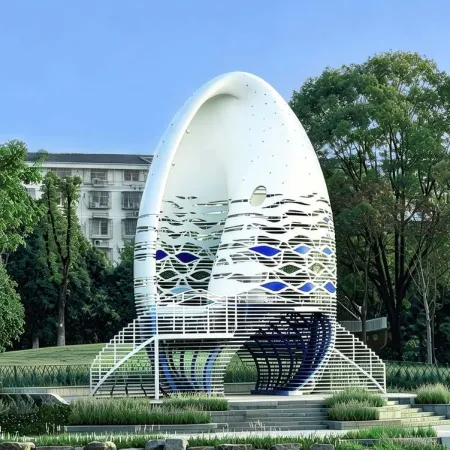
Site-specific sculpture design reaches the public when the concept, drawn from the place, is built back into the place with craft. The studio must carry the site's logic through engineering, fabrication and installation, so the work that stands is the work the site called for. See how our site-specific works have grown from their places in our project gallery, review the services that carry a site-specific commission through delivery on the services overview, and study a work such as Hello Conch, whose 12.8-metre interactive shell was drawn from its waterfront community's own story and character.
What Site-Specific Design Achieves
A work that could live nowhere else
A concept drawn from the place's own layers
A presence the community recognises as its own
Meaning that deepens as the site matures
Commissioning a Work That Belongs to Its Place
Clients commissioning site-specific sculpture design should give the studio deep access to the place and its stories. Share the site's history, the community's character, the events it has hosted and the memories it holds, because each is raw material for the concept, and give the studio time to visit, walk and absorb the location rather than expecting a concept from photographs alone. The client should also protect the process from the pressure to reuse a proven form, because a site-specific commission is an investment in originality.
The rewards of that investment are profound. A site-specific work becomes part of the place's identity in a way no portable sculpture can, accumulating memory and meaning as the years pass until the community cannot imagine the site without it. We have seen such works become the answer to the question where shall we meet, the backdrop to a thousand photographs and the symbol a community offers to visitors, and each one was possible only because it was designed for that one place, from that one place, and for the people of that one place.
The Community Workshop: Listening Before Designing
Site-specific sculpture design is enriched by workshops that bring the community into the creative conversation before the concept is fixed, and we run them as listening sessions rather than presentations. Residents share the stories the place holds, the moments they remember and the feelings they want the work to carry; local historians add the layers that living memory has forgotten; and the designers leave with a wealth of material that no site visit alone could reveal. Those workshops are where the community begins to own the work that will represent it.
The workshop also manages expectations honestly, because a community that feels consulted but ignored becomes a community that resents the finished work. We report how the voices shaped the concept, we explain the constraints that limited some ideas and we show the community the directions their input produced, so the process is transparent from beginning to end. When the sculpture is unveiled, the community recognises not only the place but also itself in the work, and that recognition is the deepest foundation a site-specific sculpture can have.
A site-specific commission also asks the client to trust the process, because the concept cannot be shown from a catalogue and the designer cannot promise a familiar result. The client must share the site generously, allow the studio time to absorb it and judge the emerging concept against the place rather than against a pre-conceived image, and the studio must earn that trust with listening, honesty and craft. When the trust is mutual, the work that results belongs to the place in a way that no other process could achieve.
Frequently Asked Questions About Site-Specific Sculpture Design
What is site-specific sculpture design?
The discipline of designing sculpture for one particular place, drawing the concept from the site's physical, historical, social and cultural layers.
How is site-specific different from a portable sculpture?
A portable work carries its own meaning anywhere, while a site-specific work draws its meaning from its one location and would lose it if moved.
How do you discover what a site needs?
Through visits at different hours, research into the place's history and character, conversations with the community and artistic response to the layers of meaning found.
Can a site-specific sculpture be relocated later?
Technically some can be moved, but the work would lose much of its meaning, which is why site-specific commissions should be planned as permanent gifts to their place.
Is site-specific design more expensive?
The research and original design add cost, but the result is a unique work of greater value to its place than a reused form could offer.
Site-specific sculpture design gives a place a work that belongs to it alone, drawn from its ground, its memory and its people. Choose a studio that reads sites deeply, resists the reusable and builds what it conceives, and your place will receive a sculpture it could not imagine living without.
If your place has a story that deserves a form of its own, share the site and its layers with us, and we will show you what site-specific sculpture design can draw from them.