Why Large Outdoor Sculpture Changes How a Place Is Seen and Remembered
Large outdoor sculpture does something that smaller works cannot: it changes the scale of the place itself, giving a district, a campus or a park a centre of gravity that people navigate by and remember. When a work rises above the everyday sightline, it stops being an object and becomes part of the geography, a fixed point in a changing world.
This guide explains what large outdoor sculpture demands of its designers, engineers and owners, and how to commission a work whose scale earns its place rather than merely dominating it.
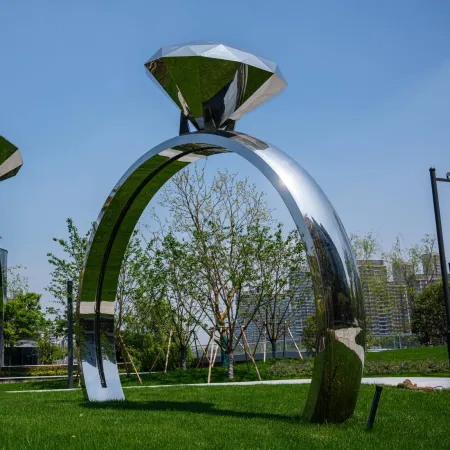
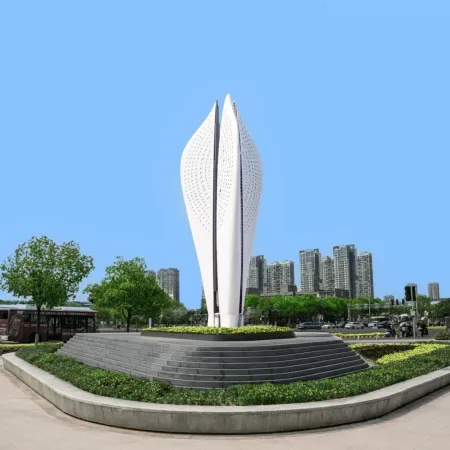
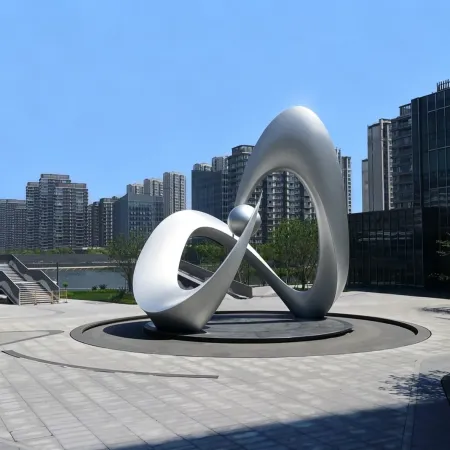
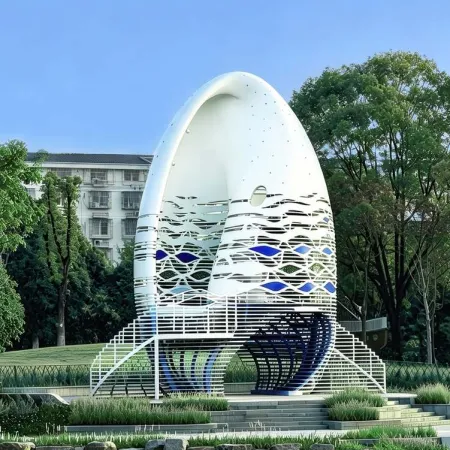
Experience the scale of Wind Sail, the presence of Zhang Cangshui and the public pull of Heart of Changfeng.
What Scale Really Does to a Place
Large outdoor sculpture operates on the skyline of daily life, and that is precisely its power. A form several metres high becomes a landmark that orients people, a meeting point that organises social life, a photographic backdrop that circulates on social media and a symbol that gives a district an identity in a few seconds of recognition. Scale is not merely size; it is the decision to enter the public memory at the level of buildings and trees rather than furniture and ornaments.
With that power comes responsibility. A large work in the wrong place can crush a delicate setting, block a view that mattered or dwarf a building it was meant to complement, so scale must be earned by the site. The studio should study the sightlines, the surrounding architecture, the movement of people and the character of the district before recommending a size, and the design should be tested against the real skyline, not just the drawing board. Scale that responds to its place feels inevitable; scale imposed on a place feels arrogant.
The Engineering of Something That Big
A large outdoor sculpture is an engineered structure before it is anything else, and the engineering begins with the forces of nature. Wind load on a tall form can be severe, so the internal structure, the connections and the foundations must all be calculated for the site's exposure; weight must be carried through a structure that does not creep or fatigue; and the ground beneath must be investigated so the foundation suits the real soil. These are not obstacles to the art but the conditions that make it possible at all.
Fabrication and installation are equally matters of engineering discipline. A large piece is usually built in sections that must be transported, lifted and joined on site with precision, and the sequence must be planned so that each element is supported through every stage. The fabricators who build the work should also supervise its erection, because they understand exactly how the sections align and connect. When the engineering is done well, the public never thinks about it; the sculpture simply stands, and that effortlessness is the highest compliment to the engineers.
| Consideration | Question to answer | Why it decides success |
|---|---|---|
| Sightlines | Where will the work be seen from? | Shape is read from roads and windows |
| Wind and weight | Can the structure carry the forces? | Survival depends on engineering |
| Ground and base | Does the soil suit the load? | Foundation follows real ground |
| Access | Can sections reach the site? | Transport shapes the sectioning |
| Maintenance | How will the work be cared for? | Access and finish decide the routine |
Designing a Silhouette That Owns the Sky
At large scale, silhouette is everything. Detail that is charming at arm's length disappears at the distance from which a large outdoor sculpture is first seen, so the form must be composed as a bold profile that reads instantly against sky, buildings and landscape. The strongest large works are often those that can be recognised in a single glance, reduced to an outline that children can draw, which is the surest test that the form has true public identity.
Yet the silhouette is only the first layer. As viewers approach, the work should reward them with progressively finer readings, surface, texture, detail, material life, so that the person who sees it daily continues to discover it. This layering of experience, bold at distance, rich up close, is what separates a great large work from a merely big one, and it is achieved by designing every scale of the experience rather than simply scaling up a small idea.
Materials and Finishes for the Long Public Life
The materials of large outdoor sculpture must be chosen for decades of exposure to sun, rain, frost and pollution, because refinishing a large work is costly and difficult. Stainless steel, in grade 316 for coastal and salt-exposed sites, offers brilliance with minimal care; weathering steel develops a stable patina that suits landscape settings; painted steel offers colour but depends on its coating system; and stone carries a quiet permanence. Each choice should be made with the site's climate and the owner's maintenance capacity in mind.
Finish quality at scale is unforgiving. A mirror surface across metres of steel magnifies every imperfection, a painted surface exposes every preparation flaw and a stone surface reveals every hasty decision, so the finishing must be planned as rigorously as the structure. The studio should specify exactly how the finish will be achieved, protected and maintained, and the owner should receive a written care guide, because at this scale the difference between good and excellent care is measured in decades of appearance.
Commissioning With Confidence
Commissioning large outdoor sculpture is a significant commitment, and it should be approached with the discipline of a construction project and the vision of an art project combined. Begin with a clear brief that includes the site, the story, the audience and the maintenance reality, then select a studio with proven work at your scale, visit or interrogate their workshop and check their engineering credentials. Agree a full budget early that includes foundations, cranage and installation, and a programme with defined approvals so the project moves with confidence.
The reward is proportionate to the commitment. A successful large outdoor sculpture becomes the image of its place, reproduced in photographs, remembered by visitors, adopted by residents and passed to future generations as part of the district's identity. The engineering fades into the background, the budget is forgotten, and what remains is the form against the sky that tells everyone who passes, in a single glance, that they have arrived somewhere with a sense of itself.
What Large Scale Delivers
A landmark that orients and gathers people
A silhouette that owns the skyline
Engineering that disappears into confidence
An identity passed to generations
Lighting a Large Work After Dark
A large outdoor sculpture does not stop working at sunset, and the studios that design great large works design their lighting as part of the form, because night is when a landmark can become truly magical. The lighting strategy should consider how the sculpture is seen from the approaches, how its surfaces reflect or absorb light and how shadows can be used to give the form drama, and it should be designed with the sculptor, not bolted on later by an electrician who has never thought about art. Uplighting from the base, grazing light that reveals surface texture, internal illumination for forms that can carry it and accent lighting that picks out the key gesture each create a different night character.
The practical side of lighting matters as much as the poetry, because outdoor lighting must survive weather, resist vandalism, serve maintenance and respect the neighbours, so the fittings should be chosen for durability, the wiring engineered for safety and the controls set to suit the site, from all-night presence to programmed scenes for events. The light should also be balanced, bright enough to reveal the work without blinding passers-by or spilling wastefully into the sky, and the energy use should be considered, since a landmark that glows every night carries a running cost. When the lighting is designed as part of the commission, a large outdoor sculpture gives its place a second life after dark.
Frequently Asked Questions About Large Outdoor Sculpture
How large does a sculpture need to be to count as large?
There is no fixed threshold, but a work generally enters the large category when it stands well above eye level and begins to operate on the skyline, typically several metres high. The right scale is decided by the site, not by a number.
Do large outdoor sculptures need planning permission?
Public works of significant scale usually require approvals from the landowner, the local authority and often additional consents. A reputable studio will advise on the approvals your site needs and support the application with proper documentation.
What is the most durable material for a large work?
For coastal and salt-exposed sites, grade 316 stainless steel is the strongest choice for bright, low-maintenance work. Weathering steel and stone also endure well, each with its own character, and the best choice follows the climate and the design.
How is a large sculpture installed?
Foundations are built first, then the sections are delivered, lifted by crane and joined on site according to a planned sequence. The fabricating studio should supervise the erection, because it knows exactly how the sections align.
How should we budget for maintenance?
Ask the studio for a written care guide and plan a simple routine, typically periodic washing plus a seasonal inspection. For painted or mirror finishes, budget for periodic attention so small issues never become large ones.
Large outdoor sculpture offers a place something no other investment can: a visible identity, a daily landmark and a gift to the future. It asks for serious engineering, honest budgeting and patient design, and it returns all of that many times over in the life it brings to a district.
Explore what large outdoor sculpture could do for your site with our experienced team today.